Showing posts with label Bashô. Show all posts

Friday, September 26, 2014

Sanzôshi 7 - Twilight of Autumn

Some more favorite verses from Akazôshi. It's way too early in the year for aki no kure, but I suppose it's always twilight on the earth, somewhere.


people’s voices —
coming home on this road
twilight of autumn

hito koe ya kono michi kaeru aki no kure
人声やこの道かへる秋の暮

on this road
no one else travels
twilight of autumn

kono michi ya yuku hito nashi ni aki no kure
この道や行く人なしに秋の暮


About this verse: Someone asked, “Which is better?” Later, he decided on “no one else travels,” and published it under the topic “Inner Thoughts 所思.”

Tuesday, September 23, 2014

Sanzôshi 6 - Six Hokku

A set of hokku from Akazôshi. Dohô lists them together as verses that Bashô revised. They're not autumn verses, but I post them in honor of the equinox and first day of autumn, as Bashô was a rather autumn/winter kind of person. 

banana tree in a storm —
a night of listening
to rain in a bucket

bashô nowaki tarai ni ame o kiku yo kana
芭蕉野分盥に雨を聞く夜かな

see you later
I’ll be snow-viewing
until I’m rolling in it

izasaraba yukimi ni korobu tokoro made
いざさらば雪見に転ぶ所まで

wintry winds —
I am just like
Chikusai 

kogarashi no mi wa Chikusai ni nitaru kana 
木がらしの身は竹斎に似たる哉


coming upon them, on a mountain road
how lovely!
wild violets

yamaji kite nani yara yukashi sumire gusa 
山路来て何やらゆかしすみれ草


a family, all of them
with canes and white hair
visting the cemetery

ie wa mina tsue ni shiraga no haka mairi
家はみな杖に白髪の墓参り 


Buddha’s birthday —
wrinkled hands pressed together
sound of rosary beads

Kanbutsu ya shiwade awasuru juzu no oto
灌仏や皺手合する数珠の音

Originally the “storm” verse had two excess morae, “nowaki shite (as it storms).” Originally the “snow-viewing” verse started with “iza yukan (so, let’s go).” “Wintry winds” originally had excess morae, “kyôku kogarashi (mad verse wintry winds).” “Wild violets” originally had “nan to naku nani yara yukashi (why, how lovely!).” “A family, all of them” originally had “ikka mina (the whole family).” “Buddha’s birthday” also originally sounded like “nehan e ya (nirvana painting);” did he revise it later? Surely there are others of this kind. All of them show our Teacher’s changes of heart, and should be appreciated. 

Wednesday, September 17, 2014

Sanzôshi 5 - Lingering Dreams

This Akazôshi passage discusses one of my favorite Bashô verses, so here it is:

Though a dim light shown from the late-month moon at the dawn of the twentieth day, the base of the mountains was deep in darkness; even the pony’s hooves clomped clumsily and several times I thought I’d fall off. In that way we passed countless miles, with no birdsong audible yet. I thought of Du Mu’s lingering dream in “Early Travel,” and woke up at Sayo-no-nakayama:

dreams linger while sleeping on horseback
the moon, in the distance
a tea-fire’s smoke 
uma ni nete zanmu tsuki tôshi cha no keburi  
馬に寝て残夢月と遠し茶の煙

About this verse: The headnote uses the words of an ancient poet to illuminate a scene. Originally, it read: “on horseback, lingering dreams as I’d like to sleep  / the moon in the distance / a tea-fire’s smoke 馬上眠からんとして残夢残月茶の煙 bajô nemukaran toshite zanmu tsuki” and at one point the first five morae were edited to read, “sleeping on horseback 馬に寝て uma ni nete;” after that, the rhythm did not seem right, so it was amended to “the moon in the distance / a tea-fire’s smoke 月遠し茶の煙 tsuki tôshi cha no keburi.”

Saigyô verse memorial at Saya-no-yamanaka Park | www.city.kakegawa.shizuoka.jp

Tuesday, September 16, 2014

Sanzôshi 4 - The Red Notebook 2 赤冊子

More Akazôshi. This part includes some of Bashô's famous statements on the balance of high and low culture in haikai, and the importance of objective observation.

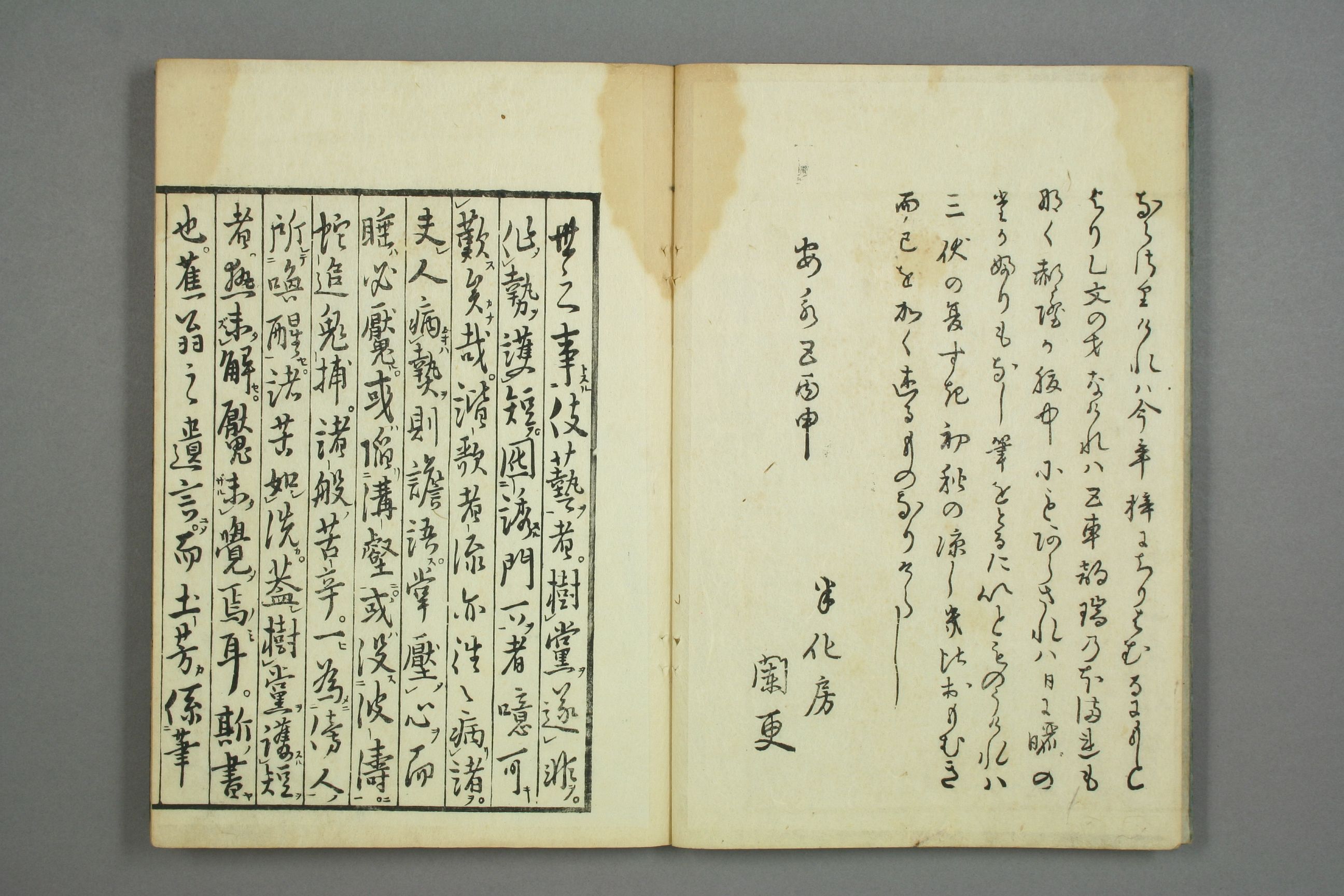
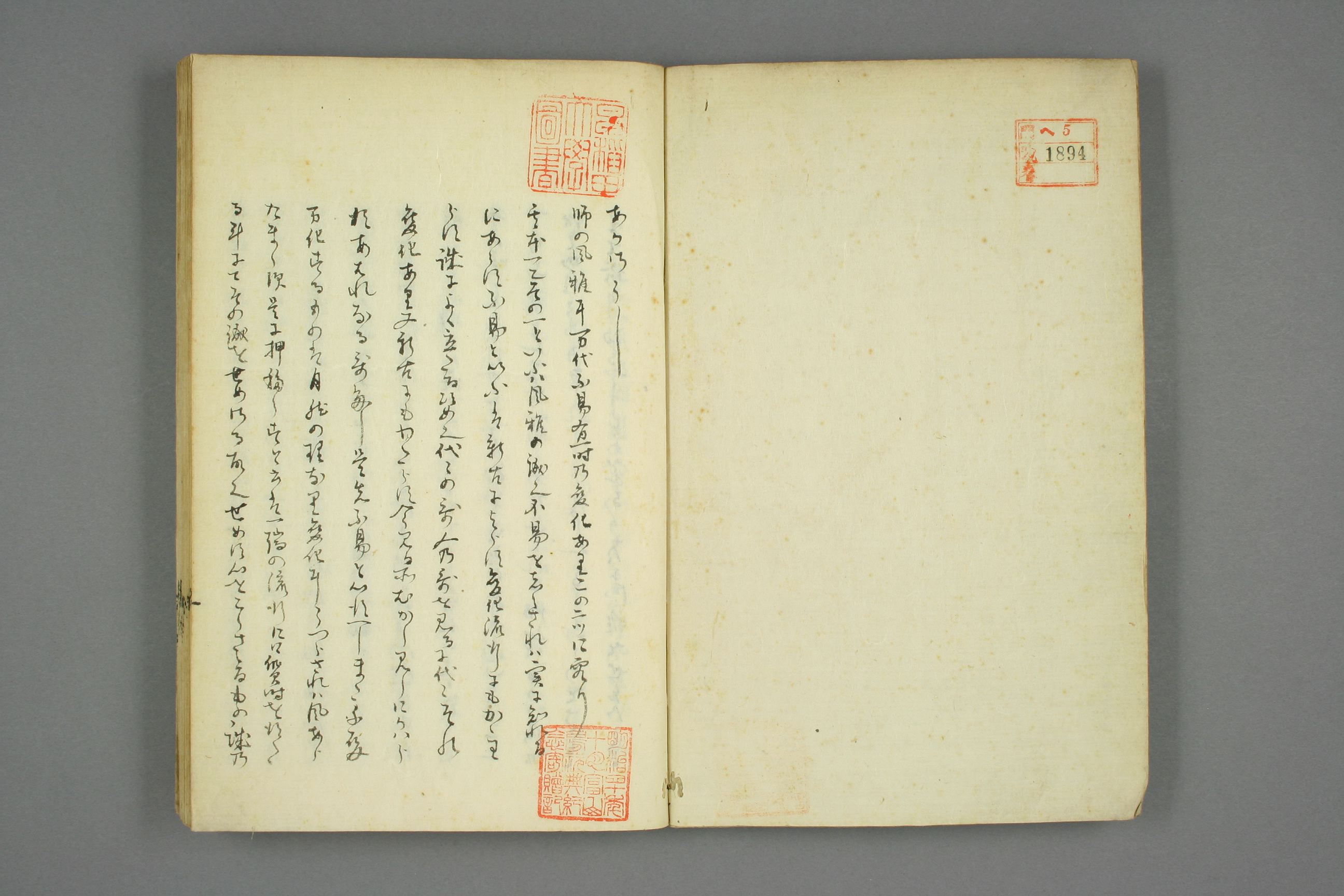
Sanzôshi, Waseda Library
One of his teachings was, “Awaken to the things of elite culture, but return to the things of the everyday life.” He said, “Always strive to awaken to aesthetic authenticity; at the same time, you must return to the haikai of the present moment.”

Because poets who always concentrate on poetic elegance unify the object about which they write with the emotion that they feel and fix it in the form of a verse, the theme they take up emerges naturally and without preconceptions. If you do not refrain from adorning your emotional response to the object, you end up with superficially decorative language. That is what is known as the spiritual vulgarity of failing to constantly strive for aesthetic authenticity. 

In striving after aesthetic authenticity, you must learn from the minds of the people of the past who mastered poetry (fûga); and, closer to our own time, comprehend the mind of our Teacher. If you do not know his mind, there is no means by which you may achieve the Path of authenticity. In order to know his mind, you must track back through the evidence of his writings, and study them well. That is to say, correcting the failings in your own mind, directing yourself towards understanding our Teacher, and working towards achieving insight is what we may call striving for authenticity.
It is poetic egocentrism to not seek the essence of what our Teacher longed for; and to instead find pleasure in his Way according to one’s own biased way of thinking, and feign being one of his disciples.  Disciples must sufficiently reflect on and correct their own shortcomings.

Our Teacher’s statement “learn about the pine from observing the pine, learn about the bamboo from observing the bamboo” also was an admonition to separate yourself from egocentrism. This admonition to “learn” refers to the fact that people usually depend on preconceived notions and in the end do not learn by observation. “Learn” means writing your verse after you immerse yourself in exploration of an object so that its particular characteristics appear and stimulate your emotion. No matter what object you write about, if the emotion is not one that emerges from that object spontaneously, object and the self remain separate, and that emotion does not achieve aesthetic authenticity. It remains a creative impulse rooted in egocentrism.

Sunday, September 14, 2014

Sanzôshi 3 - The Red Notebook 1 赤冊子

Here's a bit of Dohô's Akazôshi for a cloudy September Sunday. I'm working on this to get ready for a conference at the University of Connecticut in October:

Our Teacher’s haikai (fûga 風雅) possesses both the changelessness of countless aeons and the change of a single moment; looking carefully into each reveals that they both share a single foundation. This single foundation is called the aesthetic of authenticity (fûga no makoto 風雅の誠). If you are ignorant of changelessness, you cannot truly understand haikai. Changelessness means the quality of verse that is established by sincerely seeking aesthetic authenticity that is apart from being either new or old, and is of course not influenced by changeableness or fashions.

If you read the verse of waka poets over the generations, you see that each era had its own changes. There are many waka poems that are evocative regardless of whether they are new or old, or whether their readers are those of the present day or those of the past. It is important to understand this aspect of changelessness. 

Akazoshi, Waseda Library
Akazôshi at Waseda University Library
Moreover, transformation is a fundamental principle of Nature. Without change, style stagnates. Style does not change when poets only match their habits of writing to what happens to be fashionable at the time, without singlemindedly striving to achieve aesthetic authenticity. Poets will not understand the aesthetic authenticity of change without singlemindedly striving for and focusing their minds on it. All they can do is imitate others.  Poets who strive for aesthetic authenticity find it difficult to be content just with covering the same ground that was previously walked by others; as a rule, haikai style naturally keeps moving forward.

Regardless of how many changes there are in the future, the aesthetic authenticity of all change belongs to our Teacher’s haikai.  He said, “Do not for a minute swallow the dribblings of the ancients. All things renew themselves like the four seasons progressing forward; haikai is like everything else in this regard.” 

When our Teacher was on his deathbed, a disciple asked him about the future of haikai (fûga). Our Teacher said, “There have been numerous stylistic changes since I embarked on this Path. However, we can speak of them overall in terms of three: standard 真, semi-cursive 行, and cursive 草. Of those three, I have not yet achieved mastery of one or two.” Among the light-hearted remarks that he made during his life, something he said many times was, “The rice sack of haikai has only barely been opened.”

Sunday, February 2, 2014

Sanzôshi 2 - The White Notebook 2 白冊子


Here's the second part of the draft.

Lord Fujiwara no Teika said this about haikai. “It is cleverness. It must be something whose emotional content is false.  It applies emotional content to something that is without emotional content, and gives expression to what is without expressiveness, in a form that is clever.” In [Ming period poet Pu Yanglai’s 濮陽淶] Yuan-era rime studies compendium (Yuansheng yunxue dacheng 元聲韻學大成) “There was much word play (俳諧 haikai) in the poetic language of Zheng Qi 鄭綮 (d. 899).” “Hai” 俳 means humor; “kai” 諧 means relaxed. In the Tang period, they called humorous verse “haikai.”

There is also the term kokkei 滑稽, humor. The term kokkei was used when Guan Zhong 管仲 (c. 720-645 BCE) went to the State of Chu 楚, his answer to the Chu people was said to be kokkei. In Japan, there is the kokkei humor of Reverend Ikkyû 一休和尚 (1394-1481). Kokkei in this case was evident in the witty responses he made to people, that is to say, cleverness. In Kokinshû, the category haikaika 俳諧歌 was created to classify comic verses. With that as a model, verses that use ordinary language were generally called haikai no renga.

With that, haikai began, and for generations it was only played with as cleverness, and its pioneers remained ignorant of authenticity (makoto 誠). More recently, Baiô 梅翁 of Naniwa [Osaka’s Nishiyama Sôin 西山宗因 1605-1682] became well-known for writing in a free, relaxed style, but he achieved less than half of its potential, and still his reputation for skillfulness rests on his use of word-play.

However, our now deceased teacher Matsuo Bashô took up the path of haikai more than thirty years ago, and was the first to attain haikai’s authenticity (makoto 実). The haikai of our teacher was called by the same name, “haikai,” as was used in the past, but it was not the same haikai as it was in the past; it was the haikai of authenticity. So, although in the past there was a genre called haikai, what was it, since all the years people spent writing it was as useless as the inauthentic verses themselves.

Our teacher said, “We have no predecessors on this Path.” He also said, “If you look closely at the examples of people of the past, you can easily obtain that which you sought. Furthermore, the full range of what I conceive of now will be looked at closely by the people of the future. I fear only the estimation of the people of the future.” He said this repeatedly.

There were many people of the past who had a reputation for poetry written in Chinese and Japanese 詩歌. All of them started from and finished with authenticity (makoto 誠). Our teacher brought authenticity (makoto 誠) to that which was without it, and blazed a trail that will long endure. Authenticity  (makoto 誠) lasts the ages, and even Heaven waited long for the strong spirit of the person who brought authenticity to the haikai of our time. What a person our teacher was!

Renga and haikai share the same source. Renga and haikai both have content (kokoro 心) and language (kotoba 詞). While content  (kokoro 心) may be the same in both renga and haikai, renga and haikai diverge in terms of language  (kotoba 詞). There are many examples from the past that establish this. In the text Haikai Wordless treatise 俳諧無言抄 (Haikai Mugon shô, edited by Sôin, 1674), “Whatever is given voice in words is haikai language 俳言 (haigon). Words that might appear in renga but are pronounced with the Sino-Japanese reading are also haigon. Byôbu (folding screen), kichô (curtain screen) hyôshi (rhythm), richi no chôshi (tuning), rei naranu (irregular), and kochô (butterfly) are of this type. Words that appear once in 1,000-verse sequences, like oni (demon), onna (woman), tatsu (dragon), and tora (tiger), and so on, are haigon. Words that are avoided in renga like sakuragi (cherry tree), tobiume (flying plum tree), kumo no mine (peaks of cloud), kirisame (drizzle), kosame (light rain), kadoide (setting off), urabito (fisher), shidzunome (woman of lowly birth), and so on, appear in Haikai Wordless treatise and transcripts of the teachings of [Satomura] Jôha 里村紹巴 (1525-1602). All words of this kind are haigon.

Friday, January 31, 2014

Sanzôshi 1 - The White Notebook 1 白冊子

I've turned my attention to Sanzôshi (Three notebooks), an important collection related to the poetics of the Bashô school. I'm still working on Taorigiku, but for the time being I'm going to get through some passages to get ready for a karon 歌論 workshop on the West Coast in March. As always, this is a draft, so caveat lector.

Compiled by Hattori Dohô 服部土芳(1657-1730) in 1702.

You can find scans of early copies here at Waseda.

Haikai is Japanese poetry ( 歌 uta). Japanese poetry has existed from the time of the creation of heaven and earth. The great female deity and the great male deity (Izanami and Izanagi) came down from Heaven. First the female deity (divinity of darkness) said:

ananiye ya umaji otoko ni ahinu

“Oh, what a lovely youth I have encountered.”

The male deity (divinity of light) said, “

ananiye ya umaji otome ni ahinu


Oh, what a lovely maiden I have encountered.”

We might very well call this Japanese poetry (uta); what is felt in the heart, and emerges in words, that precisely is Japanese poetry. Thus, we regard this as the beginning of Japanese poetry.

In the age of the gods, the number of mora was not fixed. It became so in the age of humans. It became 31 mora from Susano-wo-no-mikoto. This is the verse that established it:

yakumo tatsu idumo yaegaki tumagome ni yaegaki tsukuru sono yaegaki wo

In Izumo, many layers of clouds arise
to live in seclusion with my wife
I will build a many-layered fence
And live behind that many-layered fence

As it is in the style of the land of Japan, it is called waka 和歌.

Within Japanese poetry (waka) there is renga and there is haikai. As for renga, it was given the name renga from the age of Emperor Shirakawa. Prior to having that name, it was called tsugiuta 継歌 : sequential uta. The number of verses was not fixed. In the time when Yamato Takeru no mikoto went east to subdue the barbarians, he recited this verse at Tsukuba Mountain, in Azuma:


Niibari Tsukuba wo koete iku ya kanenuru

since I crossed Tsukuba of Niibari
how many nights
have passed?

When he did, the fire-lighting youth continued the verse:

kaganabete yo ni wa kokonoyo hi ni wa tooka yo

counting them all:
as for nights, nine nights
as for days, ten days

It is said that this is the origin of renga.

In the time when Narihira was in Ise as an imperial hunter, he had this exchange with Itsukinomiya:

kachibito no wataredo nurenu e ni shi areba

since this is a river
over which a traveler may pass
without getting wet . . . .

mata Ausaka seki wa koenan

I wish that I
may again pass through Ausaka Barrier

He wrote the concluding verse with charcoal from a torch on a wine cup, the story goes.

In the era of Retired Emperor Go-Toba, Priest Zenami 禅阿弥 (Zen’a 善阿?) and Kobayashi 小林 (Hokurin? 北林) compiled the guidebooks containing the rules for avoiding repetitiveness and other linked verse regulations. This is called the “Original Canon” 本式. From this, the standards of renga have arisen. Later, there was the “New Canon” 新式.

Wednesday, November 27, 2013

Taorigiku - Hand-picked Chrysanthemums 3


I stayed for a number of days with the master, and composed one 2-person linked verse sequence.

Sankyô wrote: "In Chôfu there is an exceptional haikai poet whose pen name is said to be Kikusha. In the autumn last year I think, she 'took the moon for a travel hat,' and made compassion her walking staff, and thought to make a brief journey, she said, and in total visited 24 places related to the Founder (Shinran), and also asked to learn the Orthodox Style from me, and achieve the wish of many years.  Thus, she came here by means of a message appended to a letter from Takeoku of Hagi. Because of the Founder's teaching of reliance on Amida's vow to save all beings out of compassion, and (Bashô's) teaching to trust to the natural state of things, we know that compassion in both teachings are the same, and there are not two grounds of discipline." 

continue on
quiet and gentle  --
the misty moon

--  Sankyô

和らかに見られてすすめ朧月

傘狂

it is with humility
that I accept your vernal teachings 

-- Kikusha

教への春を笠にいただく

you receive
a year's worth
of his customary kindness

- Bunsui

お馴染の義理に一季を貰れて

文水

in love, more than anything
a non-threatening appearance

-- Taigo

恋にあぶなげなしなにより

大悟

is the place 
darkened by a frightening shadow
the holy cleansing font?

 -- Banri

おそろしい影を移したみたらしか

万裏

chanting "gate, gate"
I think I'll put away the rosary 

-- Tojû

ぎゃていぎゃていと念珠おしもむ

兎従

I'll also offer gruel for a feast
if it's a snowy morning

-- Soyô

白粥の馳走も雪の朝なれば

曽葉

mountain flowers set out
for the tea ceremony
that a bird glimpses through a window

-- Tosei

窓から鳥の覗く山茶花

杜静

The eight verses on the right-hand side of the front sheet.

Saturday, November 10, 2012

Fooling around with fûga 風雅

Some famous phrases associated with fûga (poetry, elegance) from the Bashô school.

There might be some problems with these because I'm taking them out of context. These are more or less notes to myself about their general meaning rather than 100% reliable translations. I'm just thinking about how the Bashô school describes poetic work.

  • 俳諧といへども風雅の一筋なれば姿かたちいやしく作りなすべからず。 
Though it be called haikai, it is on a continuum with everything artistic, so you should compose it in a way that is vulgar neither in content nor in form.
- Bashô, cited in Mukai Kyorai's 向井去来  Tabine ron 旅寝論

  • 詩・歌・連・俳はともに風雅なり。上三つのものには余す所もあり。その余す所まで俳はいたらずといふ所なし。 
Poetry in Chinese, waka, renga, and haikai are all artistic forms of expression. The first three have left areas unexplored. Of those unexplored areas, none may be called unreachable by haikai.

- Dohô 土芳, in Sanzôshi 三冊子.
Read more >>

Saturday, February 4, 2012

Everything Old/New is New/Old Again

Notes on 江戸文学の冒険 (Explorations in Edo Literature) that I mentioned in the post below.

I enjoyed this essay: 江戸時代文芸の新しさ…西鶴・芭蕉・近松を例に (The novelty of Edo-period literary arts: Saikaku, Bashô, Chikamatsu as examples) by 大輪靖宏 Ôwa Yasuhiro. My views about it might be a bit biased, though, by something I've been thinking about lately: the reflexive defensiveness some specialists in pre-modern literature have about the relevance of their interest to "people today," especially students. That, on the one hand, and the sense that I get from some specialists in modern literature that what we pre-modernists are interested in is somehow utterly alien and unrelated to what they do. I find it puzzling and a little sad. Perhaps in another post I might indulge in a genteel rant, but as I don't think it would be all that productive, I'll do something else first, which is write up my notes about Mr. Ôwa's essay.

The main point of the essay is that the Edo period was a time of experimentation in literature, particularly in the case of Saikaku, Bashô, and Chikamatsu. Saikaku depicted his characters with "naked" realism; Bashô's haiku has universal appeal because he included imagery like lice, fleas, and urine -- earthy stuff which you'd expect to find in modern poetry. Thus, compared with the literature of the classical period, Edo period writing has much freshness and novelty to it.

The part of the essay that stood out to me was his discussion of a comment about the modern haiku poet Hino Sōjō's 日野草城 Miyako Hotel ミヤコ・ホテル that is cited in Fukumoto Ichirô's 復本一郎 Hino Sōjō: Haiku o kaeta otoko 日野草城 俳句を変えた男 (Hino Sôjô: The man who changed haiku, Kadokawa Gakugei Shuppan, 2005). Fukumoto cites Murakami Fumihiko 村上文彦 saying, "I got interested in composing haiku after reading Hino Sôjô's series Miyako Hotel. Up until that point I knew no more haiku than Bashô's 'old pond' verse. I hadn't dreamed that haiku could have that kind of freshness to it." Ôwa says he doesn't want to talk about Hino Sôjô or Murakami Fumihiko, just that the comment uses Bashô's old pond verse as an example of the old-fashionedness of haiku.

Wednesday, February 1, 2012

On my bookshelf

Here are some books I've been looking through:

1,
江戸文学〈37〉特集 江戸の文体—その生成と文彩
Edo Literature Studies 37, Special Issue: Edo Literary Style: Its Formation and Figuration
小池 清治
 Koike Seiji
堀切 実
Horikiri Minoru
ぺりかん社 2007
Pelikansha 2007

I'm particularly interested in reading the essays:

a. 近世文体史を探る—文体指標性の喪失及び文体の創造性について
b. 漢詩文調の文体—芭蕉俳諧を中心に
c. 俳文の文体—芭蕉俳文の修辞的分析

2,
江戸文学の冒険
Explorations in Edo Literature
大輪靖宏
Ôwa Yasuhiro
翰林書房
Kanrin Shobô 2007
I'm particularly interested in reading the essays:

a. 江戸時代文芸の新しさ…西鶴・芭蕉・近松を例に(大輪靖宏)
b. 取合せ〉の可能性…実作のための芭蕉論 (峯尾文世)

Oh dear, that's as far as I'll get with this blog entry for now. Stay tuned for more.


Saturday, November 26, 2011

Steven Carter on Early Hokku (Starting verse)

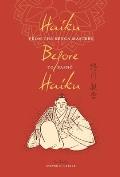
Today I'm reading Steven Carter's Haiku Before Haiku: From the Renga Masters to Bashô (bibliographic information at the bottom of the post). Professor Carter is one of the most eminent scholars in North America who works on pre-modern Japanese poetry, particularly the linked verse form renga 連歌. Renga, which one could call the collaborative form of classical waka (tanka, in the modern period), is important in its own right; and for the topic of this blog, is also of interest because it is the ancestor of haiku. Indeed, that's exactly what the title of Carter's book means.

Like everything Professor Carter writes, the book is immensely authoritative: original material is translated with precision, and the scholarly commentary is meticulously researched and clearly presented. The book includes enough detail in its notes to be useful, without being so crowded with them that it is off-putting to non-specialist readers. Haiku Before Haiku would be very useful in the classroom, for instance, or for a general reader who is looking for a reliable source on a form of Japanese poetry that has so far not gotten enough attention by anglophone readers.

I'm writing a review article of the book, but for the moment, here are some preliminary notes. When the article is published, I'll update this post with a link.

Contents summary:

1. Introductory commentary.
2. Translations and notes for hokku by 55 poets, most of them medieval but some of them early modern. The latest poet represented is Bashô.  English version appears on the left page, notes on the right, so it's easy to read in terms of format. Each poet's section begins with a very brief biographical introduction. Notes for each verse list the season, the topic, the original verse in romanized form, and includes brief contextualizing information that are useful in making sense of the translation.
3. Major poets represented (this is a really arbitrary choice): Abutsu-ni, Reizei Tamesuke, Gusai, Nijô Yoshimoto, Sôseki, Shinkei, Sôgi, Shôha, Sôchô, Arikida Moritake, Satomura Jôha, Hosokawa Yûsai, Matsunaga Teitoku, Wife of Mitsusada, Nishiyama Sôin, and Bashô.
4. Bibliography for the book and a list of Columbia U.P.'s Translations from the Asian Classics series, listed chronologically.


Haiku Before Haiku: From the Renga Masters to Bashô. By STEVEN D. CARTER. New York: Columbia University Press, 2003. 176 pp. $69.50 (cloth); $22.50 (paper).

Wednesday, October 19, 2011

Travel and the Bashô Style

Here are two key phrases from Bashô-related texts on the subject of travel and haikai. In both cases, fûga is basically synonymous with haikai.

1. 東海道の一筋しらぬ人、風雅におぼつかなし。
People who know nothing of the Tôkaidô have no understanding of fûga (poetic elegance).

-- Bashô. Cited in Sanzôshi 三冊紙 (Three notebooks).


2. 旅は風雅の花、風雅は過客の魂。
Travel is the flower of fûga; fûga is the spirit of the traveler.

-- (Bashô disciple) Kyoriku. From Infutaki 韻塞.

These phrases are discussed in a nice little book, Kazumi Yamashita's Bashô hyaku meigen 芭蕉百名言 (One hundred famous Bashô phrases), Kadokawa gakugei shuppan, 1996, 2010.