Showing posts with label calligraphy. Show all posts

Sunday, January 6, 2013

Sketchbook Project 2013: The Great Learning/大學

I finished my entry for Sketchbook Project 2013. A bit of a kakizome 書初め for the new year and a commemoration of last semester's service-learning project, it's a translation of The Great Learning. The paper in the sketchbook that you get when you sign up is not very fancy, so I took it out and rebound it using slightly heavier stock. It turned out to still be relatively transparent, but it stood up pretty well to the ink and pens that I used.

Portions of the Sketchbook Project library are displayed throughout the year in various US cities. I saw the exhibition when it came to Atlanta in the summer and it was fun. It's nice to go to an event that allows people to make art as well as view it, where it can be held and touched and not just venerated from a distance.

Eventually the Sketchbook Project people will digitize the book and post it online. In the meantime, here's what it looks like.


Click "Read More" for the rest.

Wednesday, January 2, 2013

The Way of Great Learning 大學之道

Having worked on neo-Confucianism one way or another all of last semester, I start the year with a translation of the central part of the text of Daxue (Great Learning).

大學之道,在明明德,在親民,在止於至善。知止而後有定,定而後能靜,靜而後能安,安而後能慮,慮而後能得。物有本末,事有終始,知所先後,則近道矣。

The Way of Great Learning is to make shining virtue manifestly clear, to renew the people, and to rest in the achievement of good. Knowing where to rest, then you achieve stability; with stability, then you can be calm; being calm, then you can be secure; being secure, then you can become considerate; being considerate, then you can achieve potential. Things have roots and branches; affairs have beginnings and ends; knowing what comes before and after, that will lead you closer to the Way.

古之欲明明德於天下者,先治其國;欲治其國者,先齊其家;欲齊其家者,先修其身;欲修其身者,先正其心;欲正其心者,先誠其意;欲誠其意者,先致其知,致知在格物。

In the ancient past, the people of the world who wished to make shining virtue manifestly clear first brought civil government the nation; those who wished to bring civil government to the nation first created order in their families; those who wished to create order in their families first cultivated themselves; those who wished to cultivate themselves first corrected their hearts; those who wished to correct their hearts first made their intentions sincere; those who wished to make their intentions sincere first gain knowledge. Gaining knowledge exists in the investigation of things.

物格而後知至,知至而後意誠,意誠而後心正,心正而後身修,身修而後家齊,家齊而後國治,國治而後天下平。自天子以至於庶人,壹是皆以修身為本。其本亂而末治者否矣,其所厚者薄,而其所薄者厚,未之有也!此謂知本,此謂知之至也。

After investigating things, you then achieve knowledge; having achieved knowledge, your intentions become sincere; with your intentions sincere, your heart then is corrected; with your heart corrected, your self is cultivated; with your self cultivated, then your family is ordered; with your family ordered, then your nation is governed civilly; with your nation governed civilly, all under heaven is at peace. From the Son of Heaven down to the common people, cultivation of the self is fundamental for everyone. If the root is in disarray, the branches are not orderly. It has never been the case that the important is properly treated as trivial, and the trivial as important! This cultivation of self is what is called the foundation of knowledge; this is what is called knowledge's ultimate achievement.
# # #

Before I let Daxue go, I've got one last task to commemorate it: a contribution to The Sketchbook Project 2013. The deadline is January 15, so I have to get going on it. If it's any good, I'll post scans of the pages here. Happy new year, in the meantime. Is there such a thing as 初ブログ記事? Anyway, あけましておめでとうございます。


Wednesday, December 19, 2012

Exhibition Blog

The exhibition now has its own blog!

明明徳 Clearly Manifesting Luminous Virtue

If you can't visit Clarkston, stop by the virtual galleries instead.

Wednesday, December 12, 2012

Art Exhibition Celebrates Partnership of Emory Freshmen and Clarkston Refugees

The recently opened exhibition "Clearly Manifesting Luminous Virtue" displays the brush calligraphy of students in a freshman seminar and from Clarkston Community Center's Senior Refugee Program. Despite their differences, the Emory and Clarkston students proved to have much in common: all were newcomers to the Atlanta area and all were devoted to learning. While it was not always possible to communicate with words, students learned to appreciate each other through gestures, smiles, and patient brushwork. The exhibition presents the strikingly expressive art that emerged from these sessions.

With support from Emory's Center for Community Partnerships, the group of 16 freshmen made weekly visits to the students of the Senior Refugee Classes to chat in English and share the pleasure of writing with a brush. The exhibition's title is a phrase from one of the freshman class's textbooks, The Greater Learning (Chinese, Daxue) one of the most influential works of Chinese ethics. The book explains that students should try fulfill their potential by study and practicing the arts, including calligraphy. By improving themselves, claims the Greater Learning, students are able to support their families. By supporting families, they create community. By creating community, they bring peace to the world.

Students of the freshman seminar East Asian Calligraphy in the Community, taught by associate professor of Japanese Cheryl Crowley, explored the possibilities of putting these abstract ideas into practice. They first learned the basics of the classical Chinese scholarly art of calligraphy, and then joined students from the Clarkston refugee community to collaborate in studying it during weekly visits over a period of two months. The Clarkston students, elders from the Senior Refugee Program taught by Teresa Hatton and Sheilah Bowser, attend English as a Second Language classes at the Center. They come from places as diverse as Bhutan, Somalia, and Ethiopia and Eritrea.

The exhibition is on display from December 7 - 31, 2012 at Clarkston Community Center, 3701 College Avenue, Clarkston, GA 30021 (404) 508-1050.

Additional funding was provided by Emory's East Asian Studies Program and Confucius Institute.

Saturday, November 24, 2012

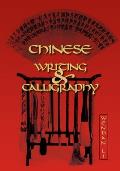
Recommended: Chinese Writing and Calligraphy

Wendan LI teaches at the University of North Carolina. I met her last month at the American Society of Shufa Calligraphy Educators' 8th International Conference on Hanzi Shufa Calligraphy Education at Southwestern University in Georgetown, Texas.

While I was there I heard about her book, Chinese Writing and Calligraphy, and it looked so good I bought a copy. It is an excellent resource both for people who are interested in learning more about calligraphy but don't have a teacher to work with, as well as teachers who would like a textbook suitable for people who don't read Chinese or Japanese.

It has a thorough introduction to the history of Chinese characters, as well as the aesthetic principles behind their construction as artistic forms. Also included are explanations of the tools of calligraphy and finally a large section of practice exercises in standard style 楷書.  What's nice about this book is that Professor Li is a specialist in linguistics, so the information she provides is scholarly and reliable. She is also a practicing calligrapher herself, so not only are the illustrations in the historical section very instructive, but the models provided in the practice exercise are so elegant and graceful you just want to copy them. In short, the book is an excellent foundational text for the anglophone classroom.

Wendan Li. Chinese Writing and Calligraphy (Latitude 20 Books). Hawaii: University of Hawai’i Press (2010) ISBN: 0824833643

Monday, October 22, 2012

Syllabus: East Asian Calligraphy in the Community

My service learning course is underway. I'll post some reflections on our work in the course soon. For now, here's the syllabus, minus the assignments schedule:

JPN 190 FIRST YEAR SEMINAR: EAST ASIAN CALLIGRAPHY IN THE COMMUNITY Made possible by a grant from the Center for Community Partnerships at Emory University

Course Description:

The class uses brush calligraphy as a focal point from which to begin exploration of common values in the cultures of East Asia, and the ways in which some of these values can enrich life in modern, globalized communities. In premodern China, Japan, and Korea, skill in brush calligraphy was one of the most important attributes of an educated, civilized person; it was regarded as a means of both learning and of demonstrating virtue.

Although it was originally developed in China, as early Koreans and Japanese embraced Chinese knowledge, they also took on Chinese writing system and calligraphy. Thus, calligraphy as a means to educate and enrich life in China became an early example of intercultural exchange in countries far from its point of origin, and continues to offer amedium of common appreciation for people from a wide range of linguistic groups and cultural backgrounds.

During the first few weeks of the class we will read fundamental texts related to East Asian philosophy. We will also practice the basic strokes of brush calligraphy. In the second part of the course, we will meet once a week on the Emory campus, and continue our study and discussion of East Asian cultural theory. The second session of class each week will be held at Clarkston Community Center, where we will join the senior learning group in practicing and assisting with students working there (transportation is provided). During the course of these sessions at CCC, students will be invited to consider the applicability of the cultural theory to their own experience, and observe their CCC classmates'experience as well. They will be asked to keep a reflection journal, and to participate in planning and organizing an exhibition of final projects at the CCC.

(Follow link to read more >>)

Wednesday, July 4, 2012

"Onna daigaku": Character Building Calligraphy II

To start part two, here's a useful list of sources on the history of women's literacy in Japan:

Link to Women and Books in Japan (Cambridge)

Okay, back to Onna daigaku. We've now reached the Kyoho period. Ishikawa tells us that in 1716, there was the simultaneous Osaka-Edo publication of Onna daigaku takarabako, the first of a flock of similarly-named texts. It followed the example of Onna Imagawa and Onna jitsugokyô in organization and content, arranged in the form of admonitions. Similarly, aside from being a reader, it was also a calligraphy copybook. Furthermore, it was profusely illustrated.

According to Ishikawa, it's not clear why this (these) texts were called Onna daigaku. The editor is not named, there is no preface, and there's no indication in the main text either. It's entirely speculative to say so, but during the early modern period education for boys was drawn from Confucian curriculum,  Song studies (= neo-Confucianism) was very influential, so the Four Books was the basis of education. The Four Books were Daxue, Zhongyong, Lunyu, and Mengzi, and of these, Daxue was the most important. So, perhaps Onna daigaku was thus named in order to function in girls' education the same way that Daxue did for that of boys? In other words, girls should have it to hand, internalize its principles -- the first, most important moral textbook.

Click "read more" for the rest.

Wednesday, June 27, 2012

"Onna daigaku": Character Building Calligraphy I

From Waseda's copy;
link is below
In the course of working on better understanding neo-Confucianism, I started thinking about Onna daigaku 女大学 (18th century), which borrows the name of the key neo-Confucian text I've been writing about here, Daxue. It's not a single text as much as a bit of shorthand to refer to a whole lineage of textbooks for women, the earliest of which is Onna daigaku takarabako 女大学宝箱 (Women's 'Great learning' jewel box), erroneously attributed to neo-Confucianist philosopher and educator Kaibara Ekken 貝原 益軒 (1630-1714).  Its content bears very little relationship to Daxue; its authors merely added the title to make the point that Onna daigaku should also be regarded as an essential basic textbook. Its intended audience was women, so there's none of the pithy, thought-provoking text of the real Daxue. Instead, it addresses specific behaviors expected from women -- how to get along in their own households and that of their husband.

The book I'm reading about it is called Onna daigaku shû (Onna daigaku anthology) 女大学集, by Ishikawa Matsutarô 石川松太郎 (Heibonsha, 1977). It covers textbooks for women starting in Hôei 7 (1711, Volume 5 of Ekken's "Girls' pedagogy," from 和俗童子訓 Precepts for Children in the Japanese Manner), with 8 more examples, the last of which is Fukuzawa Yukichi's Onna daigaku hyôron, (Critical Onna daigaku), 1899. It's got great annotations and commentary, and is illustrated with reproductions of woodblock editions of the texts it includes, so it's really useful. Right now I'm really interested in what it says about women's textbooks in the eighteenth century, so my notes here will summarize what it says about that. What caught my attention was the way that Onna daigaku demonstrates theories about relationship between moral education (or if you prefer, self-cultivation), calligraphy models, and visual imagery. Consciously setting to one side the deep unpalatability of the message about women always obeying men, I want to think more deeply about the issue of specialized textbooks for women and wonder what's here.

(Click "Read more" for the rest of this post.)

If you're curious about the content, a partial translation is available online, and you can read the whole thing as a book.

Ishikawa's commentary describes several phases in textbooks for women. Education in the early modern period for men and women was different, as there were different expectations for the roles men and women would play in the ie (household). In describing the differences, the implication is that in the 17th century most of the education was taking place in elite families, and as social organization was based in the ie, it focused on preparing people to take their respective roles. The ie included long-dead ancestors as well as newborn grandchildren. Boys were taught scholarship, martial arts, and how to maintain the continuity of the ie in which they would spend their lives. As girls would eventually leave their natal ie and join somebody else's, they also had to learn how to get along with their husband's family as well as how to raise children and perform household tasks. The requirements for being a cultivated woman was essentially possession of these four qualities: 1) wifely virtue 婦徳, 2) wifely speech 婦言, 3) wifely appearance 婦容, 4) wifely skills 婦巧. Educational materials tended to convey their message in two different ways: abstract admonition about morals was one, and illustrative stories about exemplars was the other.

The first appearance of textbooks aimed particularly at girls corresponded with a few developments -- a peaceful state, improved printing technology, and the importation of books from China. These included Chinese texts for educating girls; thus, some of the earliest Edo-period girls' textbooks were basically annotated Chinese texts. Ishikawa mentions Kumabara Banzan's Precepts for Women 女訓 (1691). Another group of texts consisted of annotations of the imported Women's Four Books 女四書 (1656), including Women's Classic of Filial Piety 女孝経, Admonitions for Women 女誡, Women's Analects 女論語, and Precepts for the Interior 内訓. Also in 1656, Kitamura Kigin published a version of (the Chinese) Biographies of Exemplary Women called Biographies of Exemplary Women in the Japanese Syllabary 仮名列女伝. This was followed by Kurozawa Hirotada's 黒沢弘忠 Japanese Biographies of Exemplary Women 本朝列女伝(1663) and Asai Ryoi's 浅井了井 Japanese Mirror for Women 本朝女鏡 (1661).

Things developed further in the eighteenth century, as access to education and books began to extend to commoners, and correspondingly there was more demand for texts that would teach women basic literacy, letter writing skills, and proper behavior. An early best seller at this stage was based on the Muromachi-era classic Imagawa Admonitions 今川状 (by Imagawa Nakaaki); it was called Onna Imagawa 女今川 and followed a similar format of bullet-point style instructions about what not to do. In addition to its content, it was important as a model for handwriting practice.
A digital version of a copy at Waseda is here.
Other kinds of textbooks followed on from late Heian/early Kamakura boy's textbooks like Teachings on Words of Truth 実語教 and Teachings for Children 童子教: Women's Admonitions Illustrated Women's Teachings on Words of Truth 女誡絵入女実語教 and Women's Admonitions Illustrated Women's Teachings for Children 女誡絵入女童子教.
A digital version of the former at Tokyo Gakugei Repository is here.  A digital version of an edition of the latter that is not illustrated, but written in exquisite calligraphy, is here.
The content emphasized developing wisdom and good moral character, as they were supposed to collect the essential teachings of the Four Books. They were also used as models for handwriting. In addition to these, there were lots of other women's textbooks published during this period, all of which combined examples of good writing with instruction in the virtues and skills required of women in maintaining the continuity of their households.

Wow! This has gotten more detailed than I'd anticipated! Ok, I'll publish this in two parts. The rest will follow before too long.

Sunday, December 11, 2011

Community-Engaged Learning Project: Initial Thoughts

Fall semester is drawing to a close here at Emory, and I really should be working on getting student grades in order. Which is exactly why I feel so compelled to think about plans for next year's fall semester. Officially this is called "structured procrastination," and otherwise, well, slacking.

However, for the past few days I've been thinking about a plan to teach a course that involves service learning, or community-engaged learning, and I want to record some of my thoughts before I forget them. In part this plan is a modest, quiet form of "occupying" with art;  in part it's a way to invite students to balance abstract, ancient principles with contemporary life and their own experience.

I've been thinking about a first-year seminar on East Asian literati culture that combines classroom lecture with hands-on practice of brush calligraphy. I chose calligraphy because it's something that even non-fluent English speakers could do, and while it's of great significance to East Asian culture it can be done by just about anybody who's willing to practice. Also, the materials are inexpensive and available. What we learn in the classroom we then take into the environment of a local community center. Emory students will join students from the community center in practicing calligraphy, and at the end of the semester we will have a group exhibition. The students will all be newcomers to campus and to Atlanta; I hope that they will learn that working for the benefit of others also brings benefit to themselves.

This is related to my interest in the cultural phenomenon of wenren (C.) / bunjin (J.) 文人, people of education and personal cultivation who make their lives a form of art. For the 18th century haikai poets who gravitated towards Buson, poetry and brush calligraphy were of immense importance, and together with reading classical texts, enabled working people living in undistinguished circumstances to feel a sense of transcendence and connection with something grand, venerable, and ancient.

I'd like my students to connect with this on a level that goes beyond just struggling to get a grade in a class. I also think that as a group we can help people in the neighborhood -- many of them refugees, or people without much in the way of financial resources -- to connect with it too. While bunjin were more likely to be recluses than community organizers, I'm interested in exploring with students to what extent we can learn from their example in terms of simplicity, benevolence, duty, and righteousness.

Sounds very grand, doesn't it? Maybe corny? I do have to keep working on it just to get to a place where I'm ready to start.

Here are some places that can suggest some directions to take this:

Emory Office of University-Community Partnerships
Campus Compact