Showing posts with label history. Show all posts
Showing posts with label history. Show all posts
Sunday, February 2, 2014
Sanzôshi 2 - The White Notebook 2 白冊子
Here's the second part of the draft.
Lord Fujiwara no Teika said this about haikai. “It is cleverness. It must be something whose emotional content is false. It applies emotional content to something that is without emotional content, and gives expression to what is without expressiveness, in a form that is clever.” In [Ming period poet Pu Yanglai’s 濮陽淶] Yuan-era rime studies compendium (Yuansheng yunxue dacheng 元聲韻學大成) “There was much word play (俳諧 haikai) in the poetic language of Zheng Qi 鄭綮 (d. 899).” “Hai” 俳 means humor; “kai” 諧 means relaxed. In the Tang period, they called humorous verse “haikai.”
There is also the term kokkei 滑稽, humor. The term kokkei was used when Guan Zhong 管仲 (c. 720-645 BCE) went to the State of Chu 楚, his answer to the Chu people was said to be kokkei. In Japan, there is the kokkei humor of Reverend Ikkyû 一休和尚 (1394-1481). Kokkei in this case was evident in the witty responses he made to people, that is to say, cleverness. In Kokinshû, the category haikaika 俳諧歌 was created to classify comic verses. With that as a model, verses that use ordinary language were generally called haikai no renga.
With that, haikai began, and for generations it was only played with as cleverness, and its pioneers remained ignorant of authenticity (makoto 誠). More recently, Baiô 梅翁 of Naniwa [Osaka’s Nishiyama Sôin 西山宗因 1605-1682] became well-known for writing in a free, relaxed style, but he achieved less than half of its potential, and still his reputation for skillfulness rests on his use of word-play.
However, our now deceased teacher Matsuo Bashô took up the path of haikai more than thirty years ago, and was the first to attain haikai’s authenticity (makoto 実). The haikai of our teacher was called by the same name, “haikai,” as was used in the past, but it was not the same haikai as it was in the past; it was the haikai of authenticity. So, although in the past there was a genre called haikai, what was it, since all the years people spent writing it was as useless as the inauthentic verses themselves.
Our teacher said, “We have no predecessors on this Path.” He also said, “If you look closely at the examples of people of the past, you can easily obtain that which you sought. Furthermore, the full range of what I conceive of now will be looked at closely by the people of the future. I fear only the estimation of the people of the future.” He said this repeatedly.
There were many people of the past who had a reputation for poetry written in Chinese and Japanese 詩歌. All of them started from and finished with authenticity (makoto 誠). Our teacher brought authenticity (makoto 誠) to that which was without it, and blazed a trail that will long endure. Authenticity (makoto 誠) lasts the ages, and even Heaven waited long for the strong spirit of the person who brought authenticity to the haikai of our time. What a person our teacher was!
Renga and haikai share the same source. Renga and haikai both have content (kokoro 心) and language (kotoba 詞). While content (kokoro 心) may be the same in both renga and haikai, renga and haikai diverge in terms of language (kotoba 詞). There are many examples from the past that establish this. In the text Haikai Wordless treatise 俳諧無言抄 (Haikai Mugon shô, edited by Sôin, 1674), “Whatever is given voice in words is haikai language 俳言 (haigon). Words that might appear in renga but are pronounced with the Sino-Japanese reading are also haigon. Byôbu (folding screen), kichô (curtain screen) hyôshi (rhythm), richi no chôshi (tuning), rei naranu (irregular), and kochô (butterfly) are of this type. Words that appear once in 1,000-verse sequences, like oni (demon), onna (woman), tatsu (dragon), and tora (tiger), and so on, are haigon. Words that are avoided in renga like sakuragi (cherry tree), tobiume (flying plum tree), kumo no mine (peaks of cloud), kirisame (drizzle), kosame (light rain), kadoide (setting off), urabito (fisher), shidzunome (woman of lowly birth), and so on, appear in Haikai Wordless treatise and transcripts of the teachings of [Satomura] Jôha 里村紹巴 (1525-1602). All words of this kind are haigon.

Friday, January 31, 2014
Sanzôshi 1 - The White Notebook 1 白冊子
I've turned my attention to Sanzôshi (Three notebooks), an important collection related to the poetics of the Bashô school. I'm still working on Taorigiku, but for the time being I'm going to get through some passages to get ready for a karon 歌論 workshop on the West Coast in March. As always, this is a draft, so caveat lector.
Compiled by Hattori Dohô 服部土芳(1657-1730) in 1702.
You can find scans of early copies here at Waseda.
Haikai is Japanese poetry ( 歌 uta). Japanese poetry has existed from the time of the creation of heaven and earth. The great female deity and the great male deity (Izanami and Izanagi) came down from Heaven. First the female deity (divinity of darkness) said:
ananiye ya umaji otoko ni ahinu
“Oh, what a lovely youth I have encountered.”
The male deity (divinity of light) said, “
ananiye ya umaji otome ni ahinu
Oh, what a lovely maiden I have encountered.”
We might very well call this Japanese poetry (uta); what is felt in the heart, and emerges in words, that precisely is Japanese poetry. Thus, we regard this as the beginning of Japanese poetry.
In the age of the gods, the number of mora was not fixed. It became so in the age of humans. It became 31 mora from Susano-wo-no-mikoto. This is the verse that established it:
yakumo tatsu idumo yaegaki tumagome ni yaegaki tsukuru sono yaegaki wo
In Izumo, many layers of clouds arise
to live in seclusion with my wife
I will build a many-layered fence
And live behind that many-layered fence
As it is in the style of the land of Japan, it is called waka 和歌.
Within Japanese poetry (waka) there is renga and there is haikai. As for renga, it was given the name renga from the age of Emperor Shirakawa. Prior to having that name, it was called tsugiuta 継歌 : sequential uta. The number of verses was not fixed. In the time when Yamato Takeru no mikoto went east to subdue the barbarians, he recited this verse at Tsukuba Mountain, in Azuma:
Niibari Tsukuba wo koete iku ya kanenuru
since I crossed Tsukuba of Niibari
how many nights
have passed?
When he did, the fire-lighting youth continued the verse:
kaganabete yo ni wa kokonoyo hi ni wa tooka yo
counting them all:
as for nights, nine nights
as for days, ten days
It is said that this is the origin of renga.
In the time when Narihira was in Ise as an imperial hunter, he had this exchange with Itsukinomiya:
kachibito no wataredo nurenu e ni shi areba
since this is a river
over which a traveler may pass
without getting wet . . . .
mata Ausaka seki wa koenan
I wish that I
may again pass through Ausaka Barrier
He wrote the concluding verse with charcoal from a torch on a wine cup, the story goes.
In the era of Retired Emperor Go-Toba, Priest Zenami 禅阿弥 (Zen’a 善阿?) and Kobayashi 小林 (Hokurin? 北林) compiled the guidebooks containing the rules for avoiding repetitiveness and other linked verse regulations. This is called the “Original Canon” 本式. From this, the standards of renga have arisen. Later, there was the “New Canon” 新式.
Compiled by Hattori Dohô 服部土芳(1657-1730) in 1702.
You can find scans of early copies here at Waseda.
Haikai is Japanese poetry ( 歌 uta). Japanese poetry has existed from the time of the creation of heaven and earth. The great female deity and the great male deity (Izanami and Izanagi) came down from Heaven. First the female deity (divinity of darkness) said:
ananiye ya umaji otoko ni ahinu
“Oh, what a lovely youth I have encountered.”
The male deity (divinity of light) said, “
ananiye ya umaji otome ni ahinu
Oh, what a lovely maiden I have encountered.”
We might very well call this Japanese poetry (uta); what is felt in the heart, and emerges in words, that precisely is Japanese poetry. Thus, we regard this as the beginning of Japanese poetry.
In the age of the gods, the number of mora was not fixed. It became so in the age of humans. It became 31 mora from Susano-wo-no-mikoto. This is the verse that established it:
yakumo tatsu idumo yaegaki tumagome ni yaegaki tsukuru sono yaegaki wo
In Izumo, many layers of clouds arise
to live in seclusion with my wife
I will build a many-layered fence
And live behind that many-layered fence
As it is in the style of the land of Japan, it is called waka 和歌.
Within Japanese poetry (waka) there is renga and there is haikai. As for renga, it was given the name renga from the age of Emperor Shirakawa. Prior to having that name, it was called tsugiuta 継歌 : sequential uta. The number of verses was not fixed. In the time when Yamato Takeru no mikoto went east to subdue the barbarians, he recited this verse at Tsukuba Mountain, in Azuma:
Niibari Tsukuba wo koete iku ya kanenuru
since I crossed Tsukuba of Niibari
how many nights
have passed?
When he did, the fire-lighting youth continued the verse:
kaganabete yo ni wa kokonoyo hi ni wa tooka yo
counting them all:
as for nights, nine nights
as for days, ten days
It is said that this is the origin of renga.
In the time when Narihira was in Ise as an imperial hunter, he had this exchange with Itsukinomiya:
kachibito no wataredo nurenu e ni shi areba
since this is a river
over which a traveler may pass
without getting wet . . . .
mata Ausaka seki wa koenan
I wish that I
may again pass through Ausaka Barrier
He wrote the concluding verse with charcoal from a torch on a wine cup, the story goes.
In the era of Retired Emperor Go-Toba, Priest Zenami 禅阿弥 (Zen’a 善阿?) and Kobayashi 小林 (Hokurin? 北林) compiled the guidebooks containing the rules for avoiding repetitiveness and other linked verse regulations. This is called the “Original Canon” 本式. From this, the standards of renga have arisen. Later, there was the “New Canon” 新式.
Sunday, January 6, 2013
Sketchbook Project 2013: The Great Learning/大學
I finished my entry for Sketchbook Project 2013. A bit of a kakizome 書初め for the new year and a commemoration of last semester's service-learning project, it's a translation of The Great Learning. The paper in the sketchbook that you get when you sign up is not very fancy, so I took it out and rebound it using slightly heavier stock. It turned out to still be relatively transparent, but it stood up pretty well to the ink and pens that I used.
Portions of the Sketchbook Project library are displayed throughout the year in various US cities. I saw the exhibition when it came to Atlanta in the summer and it was fun. It's nice to go to an event that allows people to make art as well as view it, where it can be held and touched and not just venerated from a distance.
Eventually the Sketchbook Project people will digitize the book and post it online. In the meantime, here's what it looks like.

Click "Read More" for the rest.
Portions of the Sketchbook Project library are displayed throughout the year in various US cities. I saw the exhibition when it came to Atlanta in the summer and it was fun. It's nice to go to an event that allows people to make art as well as view it, where it can be held and touched and not just venerated from a distance.
Eventually the Sketchbook Project people will digitize the book and post it online. In the meantime, here's what it looks like.

Click "Read More" for the rest.
Wednesday, January 2, 2013
The Way of Great Learning 大學之道
Having worked on neo-Confucianism one way or another all of last semester, I start the year with a translation of the central part of the text of Daxue (Great Learning).
大學之道,在明明德,在親民,在止於至善。知止而後有定,定而後能靜,靜而後能安,安而後能慮,慮而後能得。物有本末,事有終始,知所先後,則近道矣。
古之欲明明德於天下者,先治其國;欲治其國者,先齊其家;欲齊其家者,先修其身;欲修其身者,先正其心;欲正其心者,先誠其意;欲誠其意者,先致其知,致知在格物。
物格而後知至,知至而後意誠,意誠而後心正,心正而後身修,身修而後家齊,家齊而後國治,國治而後天下平。自天子以至於庶人,壹是皆以修身為本。其本亂而末治者否矣,其所厚者薄,而其所薄者厚,未之有也!此謂知本,此謂知之至也。
Before I let Daxue go, I've got one last task to commemorate it: a contribution to The Sketchbook Project 2013. The deadline is January 15, so I have to get going on it. If it's any good, I'll post scans of the pages here. Happy new year, in the meantime. Is there such a thing as 初ブログ記事? Anyway, あけましておめでとうございます。
大學之道,在明明德,在親民,在止於至善。知止而後有定,定而後能靜,靜而後能安,安而後能慮,慮而後能得。物有本末,事有終始,知所先後,則近道矣。
The Way of Great Learning is to make shining virtue manifestly clear, to renew the people, and to rest in the achievement of good. Knowing where to rest, then you achieve stability; with stability, then you can be calm; being calm, then you can be secure; being secure, then you can become considerate; being considerate, then you can achieve potential. Things have roots and branches; affairs have beginnings and ends; knowing what comes before and after, that will lead you closer to the Way.
古之欲明明德於天下者,先治其國;欲治其國者,先齊其家;欲齊其家者,先修其身;欲修其身者,先正其心;欲正其心者,先誠其意;欲誠其意者,先致其知,致知在格物。
In the ancient past, the people of the world who wished to make shining virtue manifestly clear first brought civil government the nation; those who wished to bring civil government to the nation first created order in their families; those who wished to create order in their families first cultivated themselves; those who wished to cultivate themselves first corrected their hearts; those who wished to correct their hearts first made their intentions sincere; those who wished to make their intentions sincere first gain knowledge. Gaining knowledge exists in the investigation of things.
物格而後知至,知至而後意誠,意誠而後心正,心正而後身修,身修而後家齊,家齊而後國治,國治而後天下平。自天子以至於庶人,壹是皆以修身為本。其本亂而末治者否矣,其所厚者薄,而其所薄者厚,未之有也!此謂知本,此謂知之至也。
After investigating things, you then achieve knowledge; having achieved knowledge, your intentions become sincere; with your intentions sincere, your heart then is corrected; with your heart corrected, your self is cultivated; with your self cultivated, then your family is ordered; with your family ordered, then your nation is governed civilly; with your nation governed civilly, all under heaven is at peace. From the Son of Heaven down to the common people, cultivation of the self is fundamental for everyone. If the root is in disarray, the branches are not orderly. It has never been the case that the important is properly treated as trivial, and the trivial as important! This cultivation of self is what is called the foundation of knowledge; this is what is called knowledge's ultimate achievement.
# # #
Before I let Daxue go, I've got one last task to commemorate it: a contribution to The Sketchbook Project 2013. The deadline is January 15, so I have to get going on it. If it's any good, I'll post scans of the pages here. Happy new year, in the meantime. Is there such a thing as 初ブログ記事? Anyway, あけましておめでとうございます。
Wednesday, July 4, 2012
"Onna daigaku": Character Building Calligraphy II
To start part two, here's a useful list of sources on the history of women's literacy in Japan:
Link to Women and Books in Japan (Cambridge)
Okay, back to Onna daigaku. We've now reached the Kyoho period. Ishikawa tells us that in 1716, there was the simultaneous Osaka-Edo publication of Onna daigaku takarabako, the first of a flock of similarly-named texts. It followed the example of Onna Imagawa and Onna jitsugokyô in organization and content, arranged in the form of admonitions. Similarly, aside from being a reader, it was also a calligraphy copybook. Furthermore, it was profusely illustrated.
According to Ishikawa, it's not clear why this (these) texts were called Onna daigaku. The editor is not named, there is no preface, and there's no indication in the main text either. It's entirely speculative to say so, but during the early modern period education for boys was drawn from Confucian curriculum, Song studies (= neo-Confucianism) was very influential, so the Four Books was the basis of education. The Four Books were Daxue, Zhongyong, Lunyu, and Mengzi, and of these, Daxue was the most important. So, perhaps Onna daigaku was thus named in order to function in girls' education the same way that Daxue did for that of boys? In other words, girls should have it to hand, internalize its principles -- the first, most important moral textbook.
Click "read more" for the rest.
Link to Women and Books in Japan (Cambridge)
Okay, back to Onna daigaku. We've now reached the Kyoho period. Ishikawa tells us that in 1716, there was the simultaneous Osaka-Edo publication of Onna daigaku takarabako, the first of a flock of similarly-named texts. It followed the example of Onna Imagawa and Onna jitsugokyô in organization and content, arranged in the form of admonitions. Similarly, aside from being a reader, it was also a calligraphy copybook. Furthermore, it was profusely illustrated.
According to Ishikawa, it's not clear why this (these) texts were called Onna daigaku. The editor is not named, there is no preface, and there's no indication in the main text either. It's entirely speculative to say so, but during the early modern period education for boys was drawn from Confucian curriculum, Song studies (= neo-Confucianism) was very influential, so the Four Books was the basis of education. The Four Books were Daxue, Zhongyong, Lunyu, and Mengzi, and of these, Daxue was the most important. So, perhaps Onna daigaku was thus named in order to function in girls' education the same way that Daxue did for that of boys? In other words, girls should have it to hand, internalize its principles -- the first, most important moral textbook.
Click "read more" for the rest.
Wednesday, June 27, 2012
"Onna daigaku": Character Building Calligraphy I
 |
| From Waseda's copy; link is below |
The book I'm reading about it is called Onna daigaku shû (Onna daigaku anthology) 女大学集, by Ishikawa Matsutarô 石川松太郎 (Heibonsha, 1977). It covers textbooks for women starting in Hôei 7 (1711, Volume 5 of Ekken's "Girls' pedagogy," from 和俗童子訓 Precepts for Children in the Japanese Manner), with 8 more examples, the last of which is Fukuzawa Yukichi's Onna daigaku hyôron, (Critical Onna daigaku), 1899. It's got great annotations and commentary, and is illustrated with reproductions of woodblock editions of the texts it includes, so it's really useful. Right now I'm really interested in what it says about women's textbooks in the eighteenth century, so my notes here will summarize what it says about that. What caught my attention was the way that Onna daigaku demonstrates theories about relationship between moral education (or if you prefer, self-cultivation), calligraphy models, and visual imagery. Consciously setting to one side the deep unpalatability of the message about women always obeying men, I want to think more deeply about the issue of specialized textbooks for women and wonder what's here.
(Click "Read more" for the rest of this post.)
If you're curious about the content, a partial translation is available online, and you can read the whole thing as a book.
- Excerpts from Onna daigaku (PDF, hosted by Columbia University)
- The book is called Women and Wisdom of Japan. A number of versions are kicking around on the internet. A reprint is also available as Onna Daigaku: A Treasure Box of Women's Learning from Nezu Press, 2010.
- Also, there are some amazing digitized editions available through Japanese libraries. Try this one, at Tokyo Gakugei Repository; or this one, at Waseda.
The first appearance of textbooks aimed particularly at girls corresponded with a few developments -- a peaceful state, improved printing technology, and the importation of books from China. These included Chinese texts for educating girls; thus, some of the earliest Edo-period girls' textbooks were basically annotated Chinese texts. Ishikawa mentions Kumabara Banzan's Precepts for Women 女訓 (1691). Another group of texts consisted of annotations of the imported Women's Four Books 女四書 (1656), including Women's Classic of Filial Piety 女孝経, Admonitions for Women 女誡, Women's Analects 女論語, and Precepts for the Interior 内訓. Also in 1656, Kitamura Kigin published a version of (the Chinese) Biographies of Exemplary Women called Biographies of Exemplary Women in the Japanese Syllabary 仮名列女伝. This was followed by Kurozawa Hirotada's 黒沢弘忠 Japanese Biographies of Exemplary Women 本朝列女伝(1663) and Asai Ryoi's 浅井了井 Japanese Mirror for Women 本朝女鏡 (1661).
Things developed further in the eighteenth century, as access to education and books began to extend to commoners, and correspondingly there was more demand for texts that would teach women basic literacy, letter writing skills, and proper behavior. An early best seller at this stage was based on the Muromachi-era classic Imagawa Admonitions 今川状 (by Imagawa Nakaaki); it was called Onna Imagawa 女今川 and followed a similar format of bullet-point style instructions about what not to do. In addition to its content, it was important as a model for handwriting practice.
A digital version of a copy at Waseda is here.Other kinds of textbooks followed on from late Heian/early Kamakura boy's textbooks like Teachings on Words of Truth 実語教 and Teachings for Children 童子教: Women's Admonitions Illustrated Women's Teachings on Words of Truth 女誡絵入女実語教 and Women's Admonitions Illustrated Women's Teachings for Children 女誡絵入女童子教.
A digital version of the former at Tokyo Gakugei Repository is here. A digital version of an edition of the latter that is not illustrated, but written in exquisite calligraphy, is here.The content emphasized developing wisdom and good moral character, as they were supposed to collect the essential teachings of the Four Books. They were also used as models for handwriting. In addition to these, there were lots of other women's textbooks published during this period, all of which combined examples of good writing with instruction in the virtues and skills required of women in maintaining the continuity of their households.
Wow! This has gotten more detailed than I'd anticipated! Ok, I'll publish this in two parts. The rest will follow before too long.
Tuesday, June 12, 2012
Peter Kornicki's Bibliography of Japanese History
Professor Kornicki teaches at the University of Cambridge.
The bibliography was originally compiled in 1996 and has been revised since then. It covers Japanese history up to the Meiji period, and is searchable.
The link is here:
http://www.ames.cam.ac.uk/jbib/
The bibliography was originally compiled in 1996 and has been revised since then. It covers Japanese history up to the Meiji period, and is searchable.
The link is here:
http://www.ames.cam.ac.uk/jbib/
Sunday, March 4, 2012
Elegance, virtue, and poetry: Fûgaron
Still working on Haikai to kanbungaku. However, this time the chapter is Fûgaron 風雅論 (Theories of fûga [poetic elegance]) by Ibi Takashi 揖斐高.
Fûga is a word that comes up a lot in discussions of haikai, especially when it comes to Bashô, so it makes sense to figure out where it comes from. Ibi tells us that it originates in Shijing (Classic of poetry, or Book of odes) 詩經, the collection of poems dated 10th-7th BCE that is one of the major books of the Chinese literary canon. Its contents break down into feng 風 (airs), xiaoya (lesser odes, maybe?) 小雅, daya 大雅 (grand odes?) and song 頌 (hymns). "Fûga" comes from the first three types, feng and ya, and thus is more or less synonymous with "poetry." In the early modern period, under the influence of Confucian thought, poetry = shi 詩 = kanshi, waka, and haikai = fûga.
Ibi notes that in the modern period, accounts of the history of Confucianism in early modern Japan go this way: the bakufu underpinned its social system with neo-Confucianism, which focused on the development of personal morality through self-cultivation. In the Genroku period Itô Jinsai 伊藤仁斎 advanced a kind of humanism-tinged school of thought that came to be called kogaku ("antiquarian studies"); he took a dim view of Zhu Xi's addition of Da Xue and Zhong Yong to the Confucian canon, and advocated that greater attention be paid to recapturing an "authentic" understanding of the Analects and Mencius without recourse to commentary. Later, Ogyû Sorai 荻生徂徠 picked up on a lot of the ideas put forth by Jinsai, adding in an emphasis on the appreciation and composition of music and art, which eventually resulted in the study of literature gaining independence from inquiry into ethics and politics. However, he says that this version of the story needs some more exploration.
Fûga is a word that comes up a lot in discussions of haikai, especially when it comes to Bashô, so it makes sense to figure out where it comes from. Ibi tells us that it originates in Shijing (Classic of poetry, or Book of odes) 詩經, the collection of poems dated 10th-7th BCE that is one of the major books of the Chinese literary canon. Its contents break down into feng 風 (airs), xiaoya (lesser odes, maybe?) 小雅, daya 大雅 (grand odes?) and song 頌 (hymns). "Fûga" comes from the first three types, feng and ya, and thus is more or less synonymous with "poetry." In the early modern period, under the influence of Confucian thought, poetry = shi 詩 = kanshi, waka, and haikai = fûga.
Ibi notes that in the modern period, accounts of the history of Confucianism in early modern Japan go this way: the bakufu underpinned its social system with neo-Confucianism, which focused on the development of personal morality through self-cultivation. In the Genroku period Itô Jinsai 伊藤仁斎 advanced a kind of humanism-tinged school of thought that came to be called kogaku ("antiquarian studies"); he took a dim view of Zhu Xi's addition of Da Xue and Zhong Yong to the Confucian canon, and advocated that greater attention be paid to recapturing an "authentic" understanding of the Analects and Mencius without recourse to commentary. Later, Ogyû Sorai 荻生徂徠 picked up on a lot of the ideas put forth by Jinsai, adding in an emphasis on the appreciation and composition of music and art, which eventually resulted in the study of literature gaining independence from inquiry into ethics and politics. However, he says that this version of the story needs some more exploration.
Sunday, February 12, 2012
For Valentines Day: Vulgarity, Poverty, and Poetry
Here are some notes on the first chapter of Haikai to kanbungaku 俳諧と漢文学 (Haikai and kanbun [literature in Chinese written in Japan]), Wakan Comparative Literature Association, eds. 和漢比較文学会編, 1994. (和漢比較文学叢書第16巻). The chapter is called Haikai to kanshi 俳諧と漢詩 (Haikai and kanshi [poetry in Chinese written in Japan]), and is by Hino Tatsuo 日野龍夫.
The chapter starts with a proverb, 貧の盗みに恋の歌 "Poverty makes larceny; love makes poems"; That is to say, given enough desperation, even law-abiding people might steal; likewise, smitten by romance, the most unpoetic people can be inspired to versify. Having said that, though, Hino reminds us that classical uta (歌) don't include references to poverty; uta concern themselves with elegance--nature, love etc., not matters of everyday life.
On the other hand, the classical poetry of China is full of references to poverty. Hino cites Mei Yaochen 梅堯臣 as an example, of whom Ouyang Xiu 歐陽脩 wrote, "The poorer one is the more skillful one's poetry gets. Having said that, it is not skill in poetry that makes people poor. It is probably that having become poor, afterward one develops skill." Viewed in the light of the proverb, this tells us something about the essential natures of classical waka and of kanshi.
Hino gives us this part of a famous Mei Yaochen poem, "Looking Back in Sorrow" 懷悲 :
(That's just the first half of the poem. The poor lady dies after putting up with all that.)
Hino points out that this kind of poem would never had been written by a waka poet. While poverty wasn't always a theme in Chinese poetry (not in Shi jing, anyway) it came to be included as one of the things you might write about, along with the rest of human experience, pretty much.
When Japanese haikai poets take up the theme of poverty, their stance on the matter is considerably different. Both of the following are by Buson:
The distance between haikai and kanshi is shorter than that between haikai and waka; the distance between kanshi and haikai is shorter than that between kanshi and waka, The practice of referring to poverty in haikai no doubt comes from kanshi.
Hino cites another passage from Mei Yaochen as comparison:
From "Swarm of mosquitoes" 聚蚊
Generally speaking, though, there is a big difference, between the attitude towards poverty in classical Chinese poetry and that in haikai. Chinese poets tended to write about their own experience being poor, and the main point that they're expressing is resentment for being in that state. The typical scenario is a highly educated person who either repeatedly fails the official exam and thus can't get a good job; or someone who gets a bad job (one in a remote province) and can't keep it. This isn't the sort of thing you get in Japanese poetry. Japanese poetry that mentions poverty is far more likely to present it as a form of elegant austerity -- the minimalist existence of a recluse, rather than the sad squalor of a worthy person suffering unjust deprivation.
Hino cites a very interesting passage from Gion Nankai's 祇園南海 『詩学逢原}』that I'll paraphrase:
Hino then cites this passage from the famous 20-verse series "Drinking Wine" by Tao Yuanming. This is from verse 16:
In this example from one of the Chinese poets most beloved in Japan, the speaker is poor, angry, and full of resentment.
To sum up Hino's points here, Chinese poems take on the subject of poverty; it is a "cultivated person's" 君子 own poverty expressed as a protest against an unfair government. Making such protests are the duty of a cultivated person. A cultivated person maintains his or her dignity despite reduced circumstances. Cultivated persons who were faced with hardship were supposed to complain.
In Japan, it's not that haikai poets didn't ever write about noble resentment. However, they were more interested in more subtle emotions: the pathos of the situation, rather than its injustice.
The chapter starts with a proverb, 貧の盗みに恋の歌 "Poverty makes larceny; love makes poems"; That is to say, given enough desperation, even law-abiding people might steal; likewise, smitten by romance, the most unpoetic people can be inspired to versify. Having said that, though, Hino reminds us that classical uta (歌) don't include references to poverty; uta concern themselves with elegance--nature, love etc., not matters of everyday life.
On the other hand, the classical poetry of China is full of references to poverty. Hino cites Mei Yaochen 梅堯臣 as an example, of whom Ouyang Xiu 歐陽脩 wrote, "The poorer one is the more skillful one's poetry gets. Having said that, it is not skill in poetry that makes people poor. It is probably that having become poor, afterward one develops skill." Viewed in the light of the proverb, this tells us something about the essential natures of classical waka and of kanshi.
Hino gives us this part of a famous Mei Yaochen poem, "Looking Back in Sorrow" 懷悲 :
自爾歸我家, 未嘗厭貧窶。
夜縫每至子, 朝飯輒過午。
十日九食齏, 一日儻有脯。
東西十八年, 相與同甘苦。
When you came to my home, you never resented its poverty.
Always sewing until midnight, you ate breakfast after noontime
Nine days out of ten was pickles, one day we'd have dried meat.
East and west eighteen years, together we shared the sweet and the bitter.
(That's just the first half of the poem. The poor lady dies after putting up with all that.)
Hino points out that this kind of poem would never had been written by a waka poet. While poverty wasn't always a theme in Chinese poetry (not in Shi jing, anyway) it came to be included as one of the things you might write about, along with the rest of human experience, pretty much.
When Japanese haikai poets take up the theme of poverty, their stance on the matter is considerably different. Both of the following are by Buson:
貧乏に追ひつかれけりけさの秋
overtaken
by poverty
morning in autumn
月天心貧しき町を通りけり
moon-bright heaven
all across
the slum
The distance between haikai and kanshi is shorter than that between haikai and waka; the distance between kanshi and haikai is shorter than that between kanshi and waka, The practice of referring to poverty in haikai no doubt comes from kanshi.
蚊はつらく蚊遣いぶせきうき世哉 (几董)
mosquitoes are miserable
mosquito incense a nuisance
world of sorrows (Kitô)
我にあまる罪や妻子を蚊の喰らう(大魯)
paying for my excessive sins
my wife and child
bitten by mosquitoes (Tairo)
Hino cites another passage from Mei Yaochen as comparison:
From "Swarm of mosquitoes" 聚蚊
貴人居大第,蛟綃圍枕席,
嗟爾於其中,寧誇嘴如戟。
忍哉傍窮困,曾未哀臞瘠,
利吻競相侵,飲血自求益。
Aristocrats live in big houses;
their beds are surrounded by mosquito nets;
oh, in places like that,
you'd be prouder of your piercing mouths.
Is it not cruel of you to always torment the poor?
You have no pity on those already emaciated;
You vie with one another to see who has the sharpest bite,
Drinking blood you seek to fatten yourselves.
Generally speaking, though, there is a big difference, between the attitude towards poverty in classical Chinese poetry and that in haikai. Chinese poets tended to write about their own experience being poor, and the main point that they're expressing is resentment for being in that state. The typical scenario is a highly educated person who either repeatedly fails the official exam and thus can't get a good job; or someone who gets a bad job (one in a remote province) and can't keep it. This isn't the sort of thing you get in Japanese poetry. Japanese poetry that mentions poverty is far more likely to present it as a form of elegant austerity -- the minimalist existence of a recluse, rather than the sad squalor of a worthy person suffering unjust deprivation.
Hino cites a very interesting passage from Gion Nankai's 祇園南海 『詩学逢原}』that I'll paraphrase:
Not only painting, but the koto, chess, calligraphy, and painting also all emphasize elegance. If we talk about landscape painting, when you paint the houses of people in the mountains or fields, don't include outhouses, compost piles, or cooking pots; that is bad taste. If we talk about painting people, don't include their private parts; that's obscene. Depict elegance, don't depict vulgarity.While a lot of this is similar to standards in old-style Chinese poetry, it is virtually indistinguishable from what you'd find listed as the expectations of waka. By contrast, there are plenty of poems in which haikai poets mention scatalogical topics.
Hino then cites this passage from the famous 20-verse series "Drinking Wine" by Tao Yuanming. This is from verse 16:
陶渊明飲酒二十首
敝盧交悲風, 荒草沒前庭.
披褐守長夜, 晨雞不肯鳴.
孟公不在茲, 終以翳吾情.
A mournful wind blows through the ruined house,
Wild weeds fill the garden.
Wearing old clothes, I keep watch in the long night
When dawn comes, even the rooster disdains to crow.
Duke Meng is not here,
In the end I hide away my own feelings.
In this example from one of the Chinese poets most beloved in Japan, the speaker is poor, angry, and full of resentment.
To sum up Hino's points here, Chinese poems take on the subject of poverty; it is a "cultivated person's" 君子 own poverty expressed as a protest against an unfair government. Making such protests are the duty of a cultivated person. A cultivated person maintains his or her dignity despite reduced circumstances. Cultivated persons who were faced with hardship were supposed to complain.
In Japan, it's not that haikai poets didn't ever write about noble resentment. However, they were more interested in more subtle emotions: the pathos of the situation, rather than its injustice.
Wednesday, February 1, 2012
On my bookshelf
Here are some books I've been looking through:
1,
江戸文学〈37〉特集 江戸の文体—その生成と文彩
Edo Literature Studies 37, Special Issue: Edo Literary Style: Its Formation and Figuration
I'm particularly interested in reading the essays:
a. 近世文体史を探る—文体指標性の喪失及び文体の創造性について
b. 漢詩文調の文体—芭蕉俳諧を中心に
c. 俳文の文体—芭蕉俳文の修辞的分析
2,
江戸文学の冒険
Explorations in Edo Literature
a. 江戸時代文芸の新しさ…西鶴・芭蕉・近松を例に(大輪靖宏)
b. 取合せ〉の可能性…実作のための芭蕉論 (峯尾文世)
Oh dear, that's as far as I'll get with this blog entry for now. Stay tuned for more.
1,
江戸文学〈37〉特集 江戸の文体—その生成と文彩
Edo Literature Studies 37, Special Issue: Edo Literary Style: Its Formation and Figuration
小池 清治
Koike Seiji
堀切 実
Horikiri Minoru
ぺりかん社 2007
Pelikansha 2007
I'm particularly interested in reading the essays:
a. 近世文体史を探る—文体指標性の喪失及び文体の創造性について
b. 漢詩文調の文体—芭蕉俳諧を中心に
c. 俳文の文体—芭蕉俳文の修辞的分析
2,
江戸文学の冒険
Explorations in Edo Literature
大輪靖宏I'm particularly interested in reading the essays:
Ôwa Yasuhiro
翰林書房
Kanrin Shobô 2007
a. 江戸時代文芸の新しさ…西鶴・芭蕉・近松を例に(大輪靖宏)
b. 取合せ〉の可能性…実作のための芭蕉論 (峯尾文世)
Oh dear, that's as far as I'll get with this blog entry for now. Stay tuned for more.
Tuesday, January 10, 2012
What it Was Like in the Kenkadô Kanshi Poetry Group
In thinking more about Edo period literati, I was interested by Ibi's list of rules for Kenkadô 蒹葭堂, the kanshi poetry salon run by Kimura Kenkadô in Osaka. Here they are, summarized:
1. At meetings of the poetry group, it's important to read contemplatively and seriously. You must ask questions about places you don't understand; it's not good to remain vague about things. Strive to keep a relaxed attitude and don't cause conflict. Read texts again when you leave.
2. The poetry group meets in the afternoon in spring and summer, and in the evening in autumn and winter. Namely, in the afternoon it runs from 2 pm to 4 pm; in the evening it runs from 6 pm to 8 pm. It is desirable to not be late in starting and finishing.
3. When you have to miss a meeting of the poetry group because of a personal obligation, let the group leader know in advance, and let him know when you'll definitely be able to attend next.
4. Associations within the group are like conduct among siblings. Accordingly, during meetings it is not always necessary to treat the leader differently. If this is a meeting among usual members, rank people in terms of their age; if there's a guest of honor, treat rank accordingly.
5. When the group meets, in order to compose prose and verse, decide a topic, select a rhyme scheme; you must sit quietly and revise intensely, think carefully and express yourself with skill. Don't think you have to finish quickly; what we want is for you to compose word by word, line by line, without mistakes. Idle chatter is the biggest obstacle, so it should be criticized. Private talk not allowed until everyone is finished writing. Everyone is expected to remember this.
6. Every month, on the afternoon of the first and fifteenth days, we want to go visit some scenic place in the mountains or riverside outside the city, to enjoy elegance like Confucius's disciples, "I want to bathe in the Yi River, feel the wind on Rain Altar, and return home, composing poetry." However, on those times as well we will return at nightfall.
From Edo no bunjin saron: chishikijin to geijutsukatachi 江戶の文人サロン : 知識人と芸術家たち (Literati Salons in the Edo Period: Intellectuals and Artists) by Ibi Takashi 揖斐, Yoshikawa Kôbunkan 吉川弘文館 2009, pp. 23-24.
1. At meetings of the poetry group, it's important to read contemplatively and seriously. You must ask questions about places you don't understand; it's not good to remain vague about things. Strive to keep a relaxed attitude and don't cause conflict. Read texts again when you leave.
2. The poetry group meets in the afternoon in spring and summer, and in the evening in autumn and winter. Namely, in the afternoon it runs from 2 pm to 4 pm; in the evening it runs from 6 pm to 8 pm. It is desirable to not be late in starting and finishing.
3. When you have to miss a meeting of the poetry group because of a personal obligation, let the group leader know in advance, and let him know when you'll definitely be able to attend next.
4. Associations within the group are like conduct among siblings. Accordingly, during meetings it is not always necessary to treat the leader differently. If this is a meeting among usual members, rank people in terms of their age; if there's a guest of honor, treat rank accordingly.
5. When the group meets, in order to compose prose and verse, decide a topic, select a rhyme scheme; you must sit quietly and revise intensely, think carefully and express yourself with skill. Don't think you have to finish quickly; what we want is for you to compose word by word, line by line, without mistakes. Idle chatter is the biggest obstacle, so it should be criticized. Private talk not allowed until everyone is finished writing. Everyone is expected to remember this.
6. Every month, on the afternoon of the first and fifteenth days, we want to go visit some scenic place in the mountains or riverside outside the city, to enjoy elegance like Confucius's disciples, "I want to bathe in the Yi River, feel the wind on Rain Altar, and return home, composing poetry." However, on those times as well we will return at nightfall.
From Edo no bunjin saron: chishikijin to geijutsukatachi 江戶の文人サロン : 知識人と芸術家たち (Literati Salons in the Edo Period: Intellectuals and Artists) by Ibi Takashi 揖斐, Yoshikawa Kôbunkan 吉川弘文館 2009, pp. 23-24.
Saturday, January 7, 2012
Literati Salons in the Edo Period
Today I'm reading Edo no bunjin saron: chishikijin to geijutsukatachi 江戶の文人サロン : 知識人と芸術家たち (Literati Salons in the Edo Period: Intellectuals and Artists) by Ibi Takashi 揖斐, Yoshikawa Kôbunkan 吉川弘文館 2009.

I was drawn to it because I've been thinking more about bunjin and wanted to learn more about how the term is understood. I often see it applied to Meiji intellectuals, for instance.
This book uses the word "salon" to link up the kind of social organization that educated people formed in early modern Japan with that of 18th century Paris and London (salons and coffee houses, respectively). Right away he concedes that there are some big differences -- the Japanese groups didn't admit women, and they didn't much talk about politics.
The groups he discusses include those related to the production of kanshi 漢詩 (poetry in Chinese written by Japanese people), of kyôka 狂歌 ("crazy" waka), rangaku 蘭学 (Western learning), collecting oddities, and a bit of painting as well.
It's a very serviceable introduction to/reference for important intellectuals and their associations. The comparison to salons is appropriate. I'm sorry there's not a bit more on haikai, as I really don't like kyôka very much, alas. It makes me want to find out more.
How does it relate to what I'm working on? In the most pedestrian terms possible, it's a good indication of what was going on in urban commoner culture in the 18th century. Most of the people named in the text are wealthy commoners -- shôyu brewers, merchants, etc. It helps to form a more detailed impression of what a life of creative inquiry might have been like for educated people in Edo, Kyoto, and Osaka. Haikai was part of it, but certainly not all of it.

I was drawn to it because I've been thinking more about bunjin and wanted to learn more about how the term is understood. I often see it applied to Meiji intellectuals, for instance.
This book uses the word "salon" to link up the kind of social organization that educated people formed in early modern Japan with that of 18th century Paris and London (salons and coffee houses, respectively). Right away he concedes that there are some big differences -- the Japanese groups didn't admit women, and they didn't much talk about politics.
The groups he discusses include those related to the production of kanshi 漢詩 (poetry in Chinese written by Japanese people), of kyôka 狂歌 ("crazy" waka), rangaku 蘭学 (Western learning), collecting oddities, and a bit of painting as well.
It's a very serviceable introduction to/reference for important intellectuals and their associations. The comparison to salons is appropriate. I'm sorry there's not a bit more on haikai, as I really don't like kyôka very much, alas. It makes me want to find out more.
How does it relate to what I'm working on? In the most pedestrian terms possible, it's a good indication of what was going on in urban commoner culture in the 18th century. Most of the people named in the text are wealthy commoners -- shôyu brewers, merchants, etc. It helps to form a more detailed impression of what a life of creative inquiry might have been like for educated people in Edo, Kyoto, and Osaka. Haikai was part of it, but certainly not all of it.
Saturday, November 26, 2011
Steven Carter on Early Hokku (Starting verse)
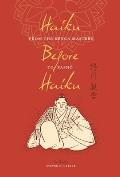
Today I'm reading Steven Carter's Haiku Before Haiku: From the Renga Masters to Bashô (bibliographic information at the bottom of the post). Professor Carter is one of the most eminent scholars in North America who works on pre-modern Japanese poetry, particularly the linked verse form renga 連歌. Renga, which one could call the collaborative form of classical waka (tanka, in the modern period), is important in its own right; and for the topic of this blog, is also of interest because it is the ancestor of haiku. Indeed, that's exactly what the title of Carter's book means.
 Like everything Professor Carter writes, the book is immensely authoritative: original material is translated with precision, and the scholarly commentary is meticulously researched and clearly presented. The book includes enough detail in its notes to be useful, without being so crowded with them that it is off-putting to non-specialist readers. Haiku Before Haiku would be very useful in the classroom, for instance, or for a general reader who is looking for a reliable source on a form of Japanese poetry that has so far not gotten enough attention by anglophone readers.
I'm writing a review article of the book, but for the moment, here are some preliminary notes. When the article is published, I'll update this post with a link.
Contents summary:
1. Introductory commentary.
2. Translations and notes for hokku by 55 poets, most of them medieval but some of them early modern. The latest poet represented is Bashô. English version appears on the left page, notes on the right, so it's easy to read in terms of format. Each poet's section begins with a very brief biographical introduction. Notes for each verse list the season, the topic, the original verse in romanized form, and includes brief contextualizing information that are useful in making sense of the translation.
3. Major poets represented (this is a really arbitrary choice): Abutsu-ni, Reizei Tamesuke, Gusai, Nijô Yoshimoto, Sôseki, Shinkei, Sôgi, Shôha, Sôchô, Arikida Moritake, Satomura Jôha, Hosokawa Yûsai, Matsunaga Teitoku, Wife of Mitsusada, Nishiyama Sôin, and Bashô.
4. Bibliography for the book and a list of Columbia U.P.'s Translations from the Asian Classics series, listed chronologically.
Haiku Before Haiku: From the Renga Masters to Bashô. By STEVEN D. CARTER. New York: Columbia University Press, 2003. 176 pp. $69.50 (cloth); $22.50 (paper).
I'm writing a review article of the book, but for the moment, here are some preliminary notes. When the article is published, I'll update this post with a link.
Contents summary:
1. Introductory commentary.
2. Translations and notes for hokku by 55 poets, most of them medieval but some of them early modern. The latest poet represented is Bashô. English version appears on the left page, notes on the right, so it's easy to read in terms of format. Each poet's section begins with a very brief biographical introduction. Notes for each verse list the season, the topic, the original verse in romanized form, and includes brief contextualizing information that are useful in making sense of the translation.
3. Major poets represented (this is a really arbitrary choice): Abutsu-ni, Reizei Tamesuke, Gusai, Nijô Yoshimoto, Sôseki, Shinkei, Sôgi, Shôha, Sôchô, Arikida Moritake, Satomura Jôha, Hosokawa Yûsai, Matsunaga Teitoku, Wife of Mitsusada, Nishiyama Sôin, and Bashô.
4. Bibliography for the book and a list of Columbia U.P.'s Translations from the Asian Classics series, listed chronologically.
Haiku Before Haiku: From the Renga Masters to Bashô. By STEVEN D. CARTER. New York: Columbia University Press, 2003. 176 pp. $69.50 (cloth); $22.50 (paper).
Sunday, November 6, 2011
Visiting the 4th-Year Class II: Sustainability and Azby Brown's "Just Enough"
Following from my previous post, I'm going to talk with the fourth-year Japanese language students about sustainability in the Edo period. This is such a huge topic, and it's difficult to know what to do with it in a single class session, but I will try to get three or four major ideas across and be happy with that.
So, in addition to the Edo shigusa stuff about avoiding waste and "nature is master, humans are followers," I'll take a couple of ideas from Azby Brown's Just Enough: Lessons in Living Green from Traditional Japan (Kodansha, 2009). I picked up the Japanese version in Tokyo this summer, 「江戸に学ぶエコ生活術」阪急コミュニケーションズ (2011).
The book is magnificently illustrated with line drawings and handwritten text. I hope the illustrations will be useful in ensuring students get the points quickly, to maximize the time that we can spend in discussion.
1. Main theme:
5. Students' responses.
6. Followup:
The book is magnificently illustrated with line drawings and handwritten text. I hope the illustrations will be useful in ensuring students get the points quickly, to maximize the time that we can spend in discussion.
1. Main theme:
吾唯足知 = ware tada taru o shiru: "I know what's just enough" is the phrase that gives the book its title, and I guess that's what I can start with. Brown's book has a nice illustration here to make the point graphically.2. What is the Edo period?
a. Timeline of Japanese history - A chart (年表 nenpyô) will be useful. (I found a potentially interesting website here that I'd like to explore further, and there's a very nice site for beginners (even college students!) here, but for now I'll just use something like this:
Timeline 年表
縄文時代 じょうもんじだい 14000-300 BCE
弥生時代 やよいじだい 300 BCE-250 CE
奈良時代 ならじだい 710-794
平安時代 へいあんじだい 794-1183
鎌倉時代 かまくらじだい 1185-1333
室町時代 むろまちじだい 1336-1573
安土桃山時代 あづちももやまじだい 1573-1603
江戸時代 えどじだい 1603-1868.........
明治時代 めいじじだい 1868-1912
大正時代 たいしょうじだい 1912-1926
昭和時代 しょうわじだい 1926-1989
平成時代 へいせいじだい 1989-
b. Map of Japan during the Edo period. Brown's book has a nice one. I will also show some pages from Nihon no kaidô 日本の街道 (Japan's historical highways ), And here's a list of links to a sampling of Edo-period maps from the University of British Columbia's library also.3. Commoners and elites - We'll look at the illustrations from different status groups.
World map, 1809
Map of Japan, pattern on porcelain vessel, 1826
Tourist map, 1818
Map of Edo, 1696
Kaizan chôriku zu, 1691
c. Social structure. Just Enough has some really good graphics to support this discussion, so I'll use those.
a. Farmers: The discussion of the water cycle is particularly interesting.4. We'll read through the assignment I mentioned in my previous post on Edo shigusa.
b. Townspeople: The section on daily life in an urban neighborhood is great.
c. Samurai: Use of interior space - fascinating
5. Students' responses.
6. Followup:
i. Invite students to take my class, "Nature and Culture in Japan."
ii. Mention this fabulous museum all about life in Edo that Wangwang and I visited last summer: The Fukagawa Edo Shiryôkan that students should really try to visit the next time they're in Tokyo. This is a small museum with a gorgeous recreation of an Edo neighborhood, lovingly and perfectly put together. The guide we met there offered us a learned, lavish and patient explanation of everything we saw. I can't recommended it enough.
iii. The Japan for Sustainability website.
Saturday, November 5, 2011
Visiting the 4th-Year Japanese Class I: Sustainability and Edo Shigusa
Dr. Yumiko Nishi asked me to stop by the fourth year Japanese class next week to talk about sustainability in the Edo period. I'm still planning what we'll talk about, but I was thinking about a couple of places to start the discussion, or frame it, or whatever.
The first is Edo shigusa (Conventions/customs of Edo).
"Edo shigusa" seems to a popular-culture phenomenon. I'm not 100% sure about it, but I get the impression it's a system developed by some modern people, especially Koshikawa Reiko 越川 禮子 to promote a rather modest kind of social change, mostly in terms of better manners and a more pleasant attitude. It's all explained in several books and the website Edo Shigusa. Basically, the theory is that merchants in the Edo period developed almost a utopia of peaceful cooperation, where respect for others and inoffensive, responsible behavior was the rule. The trouble nowadays is that everyone's forgotten these lovely old ways, and if we could just get back to them, things would be a lot better. (Koshikawa and her colleagues are available for seminars and workshops to train others in these classic principles.)
 Setting aside the question of how historically accurate this optimistic view of Edo society is, "Edo shigusa" offers a great place to start students thinking about life in early modern Japan. The manga book, マンガ版「江戸しぐさ」入門 (Manga edition: Introduction to Edo Shigusa) is great for students of Japanese language; I'll ask our students to read a couple of pages from it, the one on not wasting resources (pp. 24-25), and the one on respecting nature (pp. 32-33). I'm not reproducing them here because of copyright, but below the cut I've got a vocabulary list.
The first is Edo shigusa (Conventions/customs of Edo).
"Edo shigusa" seems to a popular-culture phenomenon. I'm not 100% sure about it, but I get the impression it's a system developed by some modern people, especially Koshikawa Reiko 越川 禮子 to promote a rather modest kind of social change, mostly in terms of better manners and a more pleasant attitude. It's all explained in several books and the website Edo Shigusa. Basically, the theory is that merchants in the Edo period developed almost a utopia of peaceful cooperation, where respect for others and inoffensive, responsible behavior was the rule. The trouble nowadays is that everyone's forgotten these lovely old ways, and if we could just get back to them, things would be a lot better. (Koshikawa and her colleagues are available for seminars and workshops to train others in these classic principles.)

Monday, October 31, 2011
Conference: Pirates, Merchants, and Cool Maps
This weekend I went to a conference at Emory called Sea Rovers, Silk, and Samurai: Maritime China in Global History. It was organized by Tonio Andrade of the History department. It was really fabulous, and brought together leading scholars on East Asian and European history (particularly of the 17th century) in various disciplines, such as military history, cartography, trade relations, and law. There were some very formidable elder celebrities such as John Wills (emeritus professor from USC) and Leonard Blusse (Leiden), but also many younger and extremely impressive scholars from all over the world as well. It was wonderful to have such a great event right here, and I was sorry I could only hear a few of the papers.
One of the things I liked about the conference was that it helped me think about Japan in the 17th century in a way I haven't before. I usually think of travel in terms of barrier stations (sekisho 関所) and highways (kaidô 街道 ); i.e., places you walk to. I don't think much about the sea. The sea seems formless and (obviously) fluid; except for harbors and beaches, it can't be named or celebrated in poetry in the same way that territory (=terra) is. And yet its significance is enormous. I can't believe I've never noticed it much, but I haven't.
One of the things I liked about the conference was that it helped me think about Japan in the 17th century in a way I haven't before. I usually think of travel in terms of barrier stations (sekisho 関所) and highways (kaidô 街道 ); i.e., places you walk to. I don't think much about the sea. The sea seems formless and (obviously) fluid; except for harbors and beaches, it can't be named or celebrated in poetry in the same way that territory (=terra) is. And yet its significance is enormous. I can't believe I've never noticed it much, but I haven't.
Friday, October 28, 2011
Conference: MARAAS at Princeton
The conference for the Mid-Atlantic Region of the Association for Asian Studies went very well. The site was Princeton, so the facilities were very fancy indeed. The organizers did a terrific job, the food was great; it was nice to stay at the nearby hotel (the Nassau Inn) and take the train in from NYC. And the library there was so wonderful. It's the first time I've been to Princeton, and while there were annoying aspects (I frown on cyclists who ride on the sidewalk when there was no reason not to be on the road) there was a lot that was nice about it also. I hope I have another chance to visit when I can spend more time in the library, at least.
Saturday, October 15, 2011
Volunteering in Miyagi (in Japanese)
From John Morris of Miyagi Gakuin Women's University
The 宮城資料ネット is soliciting volunteers to help restore historical
records rescued from tsunami affected areas. The content of the work is
described in detail below. Futhermore, accommodation is available at the
Joudo Shinshuu Honganji facitilies given at the bottom of the list.
John Morris
各位
宮城資料ネット事務局佐藤大介です。東日本大震災にかかる被災歴史資料レス
キューでは、多くの方々のご協力を賜り、改めて御礼申し上げます。
事務局(仙台市)でのボランティアにつきまして、11月の募集を行います。ご協
力いただける方は、下記の要項をお読みいただき、末尾のテンプレートに必要事
項をもれなくご記入いただいた上で、事務局宛ご返信ください。また周りにご関
心のある方がいらっしゃいましたら、ご案内いただければ幸いです。引き続きご
協力のほど、どうぞよろしくお願い申し上げます。
The 宮城資料ネット is soliciting volunteers to help restore historical
records rescued from tsunami affected areas. The content of the work is
described in detail below. Futhermore, accommodation is available at the
Joudo Shinshuu Honganji facitilies given at the bottom of the list.
John Morris
各位
宮城資料ネット事務局佐藤大介です。東日本大震災にかかる被災歴史資料レス
キューでは、多くの方々のご協力を賜り、改めて御礼申し上げます。
事務局(仙台市)でのボランティアにつきまして、11月の募集を行います。ご協
力いただける方は、下記の要項をお読みいただき、末尾のテンプレートに必要事
項をもれなくご記入いただいた上で、事務局宛ご返信ください。また周りにご関
心のある方がいらっしゃいましたら、ご案内いただければ幸いです。引き続きご
協力のほど、どうぞよろしくお願い申し上げます。
Monday, September 19, 2011
Travel in the Edo Period
Today I'm reading Edo e no shinshiten 江戸への新視点 Shûji Takashina, Yuko Tanaka 高階秀爾 田中優子 (2006); the article "Travel" 旅 by Kanamori Atsuko 金森敦子. Kanamori Atsuko has written one of the major books about Shokyûni, so she's someone I should follow.
The article starts out talking about the "closed country" policy of the Edo period, then brings up Kaempfer. While Kaempfer, being a foreigner, obviously had less time on the ground than did residents of Japan at the time, it's interesting and valuable to read his work because he writes about things that the average person wouldn't think of noticing, since he has an outsider's perspective. For instance, he points out how clean the Tôkaidô highway was. This would be unexpected, considering how much rubbish travelers would presumably generate, since they were riding horses or throwing out used straw sandals and even the trees along the roadside might be expected to litter the place with pine needles and so forth. However, it was clean to a surprising degree, Kaempfer says.
This can be accounted for because trash was treasure, from the perspective of people who lived along the highway. Horse manure was collected for fertilizer; pine straw and similar things could be used for fuel. (Unwittingly, perhaps, Kanamori gives us a nice sustainability angle here.) He also says he's amazed at the sheer number of people on the road. There are far, far more than what you'd expect to see in Europe. More people in Japan traveled.
Kanamori says that one of the best examples of travelers during this time were daimyô (lords) and their retinues, who had to make the trip between their home provinces and Edo on a regular basis, i.e., every other year. Since there were about a total of 260-70 daimyô, that meant a pretty large number were on the road. Big travel months were the Fourth Month for the daimyô, and for ordinary people, the First through the Third, the agricultural off-season. Aside from that, retainers would travel on various duties, as would merchants, and their were always a lot of pilgrims visiting various temples and shrines. Kaempfer says of Ise Shrine, while pilgrimage could happen any time, spring was a big season for it, and people would go together in huge groups and the roads would be full of them.
Some more interesting points about Ise pilgrimage: Ise and its environs were crowded with places to stay, from fancy luxury inns for the wealthy and cheap flophouses for the poor. There were also lots of entertaining things to do there besides the pilgrimage. Kanemori calls it a "wonderland." Thus you could well decide to go, whether you were a strict believer or not.
Also, while travel was expensive then as it is now, even if you ran out of money it wasn't that difficult to raise funds along the way, since people felt it was lucky to give money to pilgrims.
Even more interesting is the section on young people traveling. Apparently it was not uncommon for teenagers to run off and join a group traveling to Ise, or even children under the age of 10. You could tell that they'd run away because a lot of them were dressed in summer clothes even in the winter. Parents were not supposed to know, though in some cases they did but didn't stop them, because they assumed that facing the privations of travel was a good way to get their kids to grow up a bit.
Some other interesting points: While it was possible to use official services to send word home, people often gave letters to travelers going back in the direction of home. Also, a lot of people didn't actually carry their luggage, but used luggage forwarding services that would carry it between post towns (just like you can between Magome and Tsumago today). Thus when you see woodblock prints with travelers, the fact that they aren't dragging around their bags isn't artistic license.
Is she getting all this from Kaempfer, I wonder? I need to take a look at Kaempfer.
The article starts out talking about the "closed country" policy of the Edo period, then brings up Kaempfer. While Kaempfer, being a foreigner, obviously had less time on the ground than did residents of Japan at the time, it's interesting and valuable to read his work because he writes about things that the average person wouldn't think of noticing, since he has an outsider's perspective. For instance, he points out how clean the Tôkaidô highway was. This would be unexpected, considering how much rubbish travelers would presumably generate, since they were riding horses or throwing out used straw sandals and even the trees along the roadside might be expected to litter the place with pine needles and so forth. However, it was clean to a surprising degree, Kaempfer says.
This can be accounted for because trash was treasure, from the perspective of people who lived along the highway. Horse manure was collected for fertilizer; pine straw and similar things could be used for fuel. (Unwittingly, perhaps, Kanamori gives us a nice sustainability angle here.) He also says he's amazed at the sheer number of people on the road. There are far, far more than what you'd expect to see in Europe. More people in Japan traveled.
Kanamori says that one of the best examples of travelers during this time were daimyô (lords) and their retinues, who had to make the trip between their home provinces and Edo on a regular basis, i.e., every other year. Since there were about a total of 260-70 daimyô, that meant a pretty large number were on the road. Big travel months were the Fourth Month for the daimyô, and for ordinary people, the First through the Third, the agricultural off-season. Aside from that, retainers would travel on various duties, as would merchants, and their were always a lot of pilgrims visiting various temples and shrines. Kaempfer says of Ise Shrine, while pilgrimage could happen any time, spring was a big season for it, and people would go together in huge groups and the roads would be full of them.
Some more interesting points about Ise pilgrimage: Ise and its environs were crowded with places to stay, from fancy luxury inns for the wealthy and cheap flophouses for the poor. There were also lots of entertaining things to do there besides the pilgrimage. Kanemori calls it a "wonderland." Thus you could well decide to go, whether you were a strict believer or not.
Also, while travel was expensive then as it is now, even if you ran out of money it wasn't that difficult to raise funds along the way, since people felt it was lucky to give money to pilgrims.
Even more interesting is the section on young people traveling. Apparently it was not uncommon for teenagers to run off and join a group traveling to Ise, or even children under the age of 10. You could tell that they'd run away because a lot of them were dressed in summer clothes even in the winter. Parents were not supposed to know, though in some cases they did but didn't stop them, because they assumed that facing the privations of travel was a good way to get their kids to grow up a bit.
Some other interesting points: While it was possible to use official services to send word home, people often gave letters to travelers going back in the direction of home. Also, a lot of people didn't actually carry their luggage, but used luggage forwarding services that would carry it between post towns (just like you can between Magome and Tsumago today). Thus when you see woodblock prints with travelers, the fact that they aren't dragging around their bags isn't artistic license.
Is she getting all this from Kaempfer, I wonder? I need to take a look at Kaempfer.
Subscribe to:
Posts (Atom)