Showing posts with label haiku. Show all posts

Friday, March 13, 2015

Return of Spring

This verse is included near the end of Volume 1 of Kikusha's Hand-picked Chrysanthemums. It was written by her younger brother Tamon, whose haikai name was Konshi. 

Happy that today or tomorrow, the deeply missed Lady of the Ichiji-an Studio will finally return home: 
as I waited
I learned its fragrance --
old plum tree
machi etari sono ka narawamu toshi no ume
待得たり其香習はむ年の梅   一陽居今始

It's been warmer this week, so I feel like spring might really be on its way finally.

Sunday, November 9, 2014

More Autumnal Kikusha

Today I've got a very sad poem sequence, also from Kikusha. Kikusha's Chinese poetry is very hard for me, so this is by no means perfect. I hope it at least give a hint of the remarkable range of this talented, perpetually questing woman.

(一)
二十年来忘累機
風雲誘処促単衣
環郷松菊東籬遍
禄髪為霜去不帰

(二)
幾年逃世片心微
孤錫帰来叩旧扉
愁殺荒涼深竹色
此君今独立依依

うきわれを照せ昔の秋の月


Headnote: Already more than 20 years have passed since I became a widow, and I have been traveling from east to west. In the autumn of 1798 I returned home, and happened to visit my father-in-law's house. I wrote these two verses to express some of my feelings then.

I.
Twenty years have passed and I have forgotten many moments
Since the spirit of travel beckoned me and I set out with just a single garment.
Going back to my hometown, pines and chrysanthemums are everywhere east of the fence
My black hair turned to frost before I returned from far away.

II.
I grew tired of avoiding the world after countless years,
Returning home with my solitary traveler's staff I knocked on my old door.
I was overwhelmed by sadness, and a deep sorrow
Where he had been now flourishes lonely longing.

shine your light on me,
as I mourn for a distant past --
autumn moon

Sunday, November 2, 2014

Kikusha, for All Saints / Day of the Dead

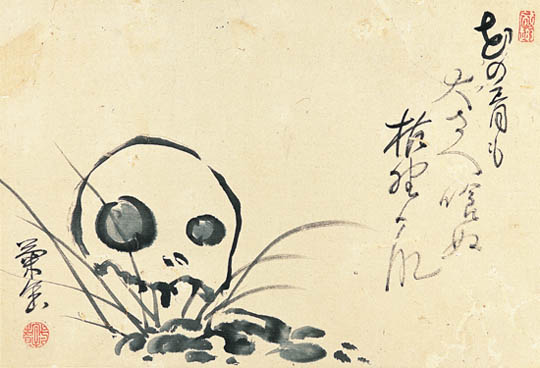
Kikusha wrote some very interesting works: poems in Chinese that were followed with a hokku, in the style of Manyôshû chôka (long courtly-style verse) that were concluded with hanka ("envoy" verses). I am not sure this is right. I've followed the interpretation in Isobe Masaru's 磯辺勝 Edo haiga kikō: Buson no hanami, Issa no shōgatsu 江戶俳画紀行 - 蕪村の花見、一茶の正月 (央公論新社, 2008).


題髑髏図

借問誰家子
紅顔墜露前
懐余這箇物
風動薄茅辺

花の骨ながら犬さへ喰へぬかな

Topic: Skull Picture

May I ask, what family’s child was this?
Still young, fallen frail as the dew.
I ponder on these things that remain
Wayside weeds and grasses, blown by the wind.

withered miscanthus may be called “flower bones”
but they are not
for dogs to gnaw

The picture comes from the Kikusha Commemoration Society's site.

Saturday, October 25, 2014

The Courtesan Kasen

Here are some hokku by Kasen 哥川 (ca. 1716-1776). I'm sure I've read some of these wrong, but here they are anyway. Courtesans led tragic, frequently brutal lives. These verses, however, are very evocative and romantic.

upon awakening
I tuned my koto
to the sound of spring rain

目覚ましに琴調べけり春の雨

envious that
snow does not gather on its branches
the plum tree itself blossoms

うらやましつもらぬ雪の梅もさき


without tying back
her beautiful hair --
willow tree

美しいかみもゆはずに柳かな


morning glory --
I too, await someone,
taking a flower for my companion

夕顔やわれも人まつ花のとも


when tying back my hair
I gaze outside --
scattered poppy blossoms

かみゆふて見れば散りたりけしの花

airing out clothes --
a cherished letter
falls from her sleeve

虫干しや恋しきふみのたもとより

These are in Nakajima Michiko's 中島道子 Yûjo Kasen: Echizen Mikuni-minato no haijin 遊女哥川: 越前三国湊の俳人 (渓声出版 [1985]). It's a biographical novel. Sometimes it's so sad/horrific I find it hard to read; it's full of useful information, though.

Sunday, February 2, 2014

Sanzôshi 2 - The White Notebook 2 白冊子


Here's the second part of the draft.

Lord Fujiwara no Teika said this about haikai. “It is cleverness. It must be something whose emotional content is false.  It applies emotional content to something that is without emotional content, and gives expression to what is without expressiveness, in a form that is clever.” In [Ming period poet Pu Yanglai’s 濮陽淶] Yuan-era rime studies compendium (Yuansheng yunxue dacheng 元聲韻學大成) “There was much word play (俳諧 haikai) in the poetic language of Zheng Qi 鄭綮 (d. 899).” “Hai” 俳 means humor; “kai” 諧 means relaxed. In the Tang period, they called humorous verse “haikai.”

There is also the term kokkei 滑稽, humor. The term kokkei was used when Guan Zhong 管仲 (c. 720-645 BCE) went to the State of Chu 楚, his answer to the Chu people was said to be kokkei. In Japan, there is the kokkei humor of Reverend Ikkyû 一休和尚 (1394-1481). Kokkei in this case was evident in the witty responses he made to people, that is to say, cleverness. In Kokinshû, the category haikaika 俳諧歌 was created to classify comic verses. With that as a model, verses that use ordinary language were generally called haikai no renga.

With that, haikai began, and for generations it was only played with as cleverness, and its pioneers remained ignorant of authenticity (makoto 誠). More recently, Baiô 梅翁 of Naniwa [Osaka’s Nishiyama Sôin 西山宗因 1605-1682] became well-known for writing in a free, relaxed style, but he achieved less than half of its potential, and still his reputation for skillfulness rests on his use of word-play.

However, our now deceased teacher Matsuo Bashô took up the path of haikai more than thirty years ago, and was the first to attain haikai’s authenticity (makoto 実). The haikai of our teacher was called by the same name, “haikai,” as was used in the past, but it was not the same haikai as it was in the past; it was the haikai of authenticity. So, although in the past there was a genre called haikai, what was it, since all the years people spent writing it was as useless as the inauthentic verses themselves.

Our teacher said, “We have no predecessors on this Path.” He also said, “If you look closely at the examples of people of the past, you can easily obtain that which you sought. Furthermore, the full range of what I conceive of now will be looked at closely by the people of the future. I fear only the estimation of the people of the future.” He said this repeatedly.

There were many people of the past who had a reputation for poetry written in Chinese and Japanese 詩歌. All of them started from and finished with authenticity (makoto 誠). Our teacher brought authenticity (makoto 誠) to that which was without it, and blazed a trail that will long endure. Authenticity  (makoto 誠) lasts the ages, and even Heaven waited long for the strong spirit of the person who brought authenticity to the haikai of our time. What a person our teacher was!

Renga and haikai share the same source. Renga and haikai both have content (kokoro 心) and language (kotoba 詞). While content  (kokoro 心) may be the same in both renga and haikai, renga and haikai diverge in terms of language  (kotoba 詞). There are many examples from the past that establish this. In the text Haikai Wordless treatise 俳諧無言抄 (Haikai Mugon shô, edited by Sôin, 1674), “Whatever is given voice in words is haikai language 俳言 (haigon). Words that might appear in renga but are pronounced with the Sino-Japanese reading are also haigon. Byôbu (folding screen), kichô (curtain screen) hyôshi (rhythm), richi no chôshi (tuning), rei naranu (irregular), and kochô (butterfly) are of this type. Words that appear once in 1,000-verse sequences, like oni (demon), onna (woman), tatsu (dragon), and tora (tiger), and so on, are haigon. Words that are avoided in renga like sakuragi (cherry tree), tobiume (flying plum tree), kumo no mine (peaks of cloud), kirisame (drizzle), kosame (light rain), kadoide (setting off), urabito (fisher), shidzunome (woman of lowly birth), and so on, appear in Haikai Wordless treatise and transcripts of the teachings of [Satomura] Jôha 里村紹巴 (1525-1602). All words of this kind are haigon.

Friday, January 31, 2014

Sanzôshi 1 - The White Notebook 1 白冊子

I've turned my attention to Sanzôshi (Three notebooks), an important collection related to the poetics of the Bashô school. I'm still working on Taorigiku, but for the time being I'm going to get through some passages to get ready for a karon 歌論 workshop on the West Coast in March. As always, this is a draft, so caveat lector.

Compiled by Hattori Dohô 服部土芳(1657-1730) in 1702.

You can find scans of early copies here at Waseda.

Haikai is Japanese poetry ( 歌 uta). Japanese poetry has existed from the time of the creation of heaven and earth. The great female deity and the great male deity (Izanami and Izanagi) came down from Heaven. First the female deity (divinity of darkness) said:

ananiye ya umaji otoko ni ahinu

“Oh, what a lovely youth I have encountered.”

The male deity (divinity of light) said, “

ananiye ya umaji otome ni ahinu


Oh, what a lovely maiden I have encountered.”

We might very well call this Japanese poetry (uta); what is felt in the heart, and emerges in words, that precisely is Japanese poetry. Thus, we regard this as the beginning of Japanese poetry.

In the age of the gods, the number of mora was not fixed. It became so in the age of humans. It became 31 mora from Susano-wo-no-mikoto. This is the verse that established it:

yakumo tatsu idumo yaegaki tumagome ni yaegaki tsukuru sono yaegaki wo

In Izumo, many layers of clouds arise
to live in seclusion with my wife
I will build a many-layered fence
And live behind that many-layered fence

As it is in the style of the land of Japan, it is called waka 和歌.

Within Japanese poetry (waka) there is renga and there is haikai. As for renga, it was given the name renga from the age of Emperor Shirakawa. Prior to having that name, it was called tsugiuta 継歌 : sequential uta. The number of verses was not fixed. In the time when Yamato Takeru no mikoto went east to subdue the barbarians, he recited this verse at Tsukuba Mountain, in Azuma:


Niibari Tsukuba wo koete iku ya kanenuru

since I crossed Tsukuba of Niibari
how many nights
have passed?

When he did, the fire-lighting youth continued the verse:

kaganabete yo ni wa kokonoyo hi ni wa tooka yo

counting them all:
as for nights, nine nights
as for days, ten days

It is said that this is the origin of renga.

In the time when Narihira was in Ise as an imperial hunter, he had this exchange with Itsukinomiya:

kachibito no wataredo nurenu e ni shi areba

since this is a river
over which a traveler may pass
without getting wet . . . .

mata Ausaka seki wa koenan

I wish that I
may again pass through Ausaka Barrier

He wrote the concluding verse with charcoal from a torch on a wine cup, the story goes.

In the era of Retired Emperor Go-Toba, Priest Zenami 禅阿弥 (Zen’a 善阿?) and Kobayashi 小林 (Hokurin? 北林) compiled the guidebooks containing the rules for avoiding repetitiveness and other linked verse regulations. This is called the “Original Canon” 本式. From this, the standards of renga have arisen. Later, there was the “New Canon” 新式.

Wednesday, November 27, 2013

Taorigiku - Hand-picked Chrysanthemums 3


I stayed for a number of days with the master, and composed one 2-person linked verse sequence.

Sankyô wrote: "In Chôfu there is an exceptional haikai poet whose pen name is said to be Kikusha. In the autumn last year I think, she 'took the moon for a travel hat,' and made compassion her walking staff, and thought to make a brief journey, she said, and in total visited 24 places related to the Founder (Shinran), and also asked to learn the Orthodox Style from me, and achieve the wish of many years.  Thus, she came here by means of a message appended to a letter from Takeoku of Hagi. Because of the Founder's teaching of reliance on Amida's vow to save all beings out of compassion, and (Bashô's) teaching to trust to the natural state of things, we know that compassion in both teachings are the same, and there are not two grounds of discipline." 

continue on
quiet and gentle  --
the misty moon

--  Sankyô

和らかに見られてすすめ朧月

傘狂

it is with humility
that I accept your vernal teachings 

-- Kikusha

教への春を笠にいただく

you receive
a year's worth
of his customary kindness

- Bunsui

お馴染の義理に一季を貰れて

文水

in love, more than anything
a non-threatening appearance

-- Taigo

恋にあぶなげなしなにより

大悟

is the place 
darkened by a frightening shadow
the holy cleansing font?

 -- Banri

おそろしい影を移したみたらしか

万裏

chanting "gate, gate"
I think I'll put away the rosary 

-- Tojû

ぎゃていぎゃていと念珠おしもむ

兎従

I'll also offer gruel for a feast
if it's a snowy morning

-- Soyô

白粥の馳走も雪の朝なれば

曽葉

mountain flowers set out
for the tea ceremony
that a bird glimpses through a window

-- Tosei

窓から鳥の覗く山茶花

杜静

The eight verses on the right-hand side of the front sheet.

Tuesday, November 26, 2013

Taorigiku - Handpicked Chrysanthemums 2


In the middle of the Tenth Month I took a boat from Mitajiri and we rowed toward Naniwazu (Osaka). I wrote this in the shallows at Suma:

traveling along the sea routes --
at both Suma and Awaji,
plovers

舩路行ば須磨に淡路に千鳥哉

At the beginning of the Eleventh Month we arrived at Naniwazu. I intended to visit the famous places there, but so as not to be late to attend the Gratitude Ceremonies for my esteemed teacher I hurried on to Kyoto. At Honganji I spent seven nights and days attending the sutra readings, and wrote:

thinking of what I owe my teacher
the snow on my travel hat
feels like nothing at all

報恩をおもへばかろし雪の笠

I have just now
arrived but already 
it is the Gratitude Ceremony

今はただ参るばかりが報恩講

As soon as the sutra readings were over, I returned at once to Naniwazu, and on New Year's Eve I went to Kôzu Shrine and wrote:

above all
I visited the shrine at the summit --
first light

高き屋をまづ拝みけり初日影

[Nintoku's waka: 高き屋にのぼりて見れば 煙 ( けぶり ) 立つ民のかまどはにぎはひにけり(新古707)]

A man called Tani Kiyobei lives here. His manner is extremely gentle, and he was sympathetic to my situation as a traveler, and from the day that I first arrived in Naniwa, and I greatly appreciate his kindness in letting me stay with him for a long time. When I finally decided to get back on the road, I wrote:

I even regret departing --
wearing traveling clothes
under Naniwa's plum blossoms

立つも惜し梅の難波の旅衣

I returned to Kyoto. and became friendly with the haikai poet Wazen, and one day we went to a plum-blossom filled valley at Fushimi, and looking at the blossoms I wrote:

too bad the scent
is blowing in the other direction --
wild plum blossoms

吹方へ薫りおしまぬ野梅かな

thatched roof
where I shall I go to seek for them --
plum blossoms

-- The Nun Wasen

藁葺のどちらへ乞はむ梅の花 倭泉

I left Kyoto, and on the road I took resuming my journey, I gazed at the capital's opulent spring scenery, and following the Omi Road from Sanetsu in Shiga I caught sight of the spring colors of the lake and it had many attractions.

In the lake 
I saw consequences --
a blizzard of blossoms

湖に果は見えけり花雪吹

Around the end of the Second Month, I arrived at Mino Province, and wrote this when I went to visit haikai master Sankyô:

blooming flowers
now in reach --
I'm simply happy

咲花に今届く手ただ嬉し

the gorgeous sincerity
of the longing that brought you here 

- Sankyô

したい来たとの誠うららか 

傘狂

I stayed for a number of days with the master, and composed one 2-person linked verse sequence.