Saturday, November 26, 2011

Steven Carter on Early Hokku (Starting verse)

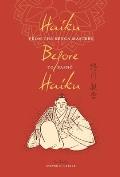
Today I'm reading Steven Carter's Haiku Before Haiku: From the Renga Masters to Bashô (bibliographic information at the bottom of the post). Professor Carter is one of the most eminent scholars in North America who works on pre-modern Japanese poetry, particularly the linked verse form renga 連歌. Renga, which one could call the collaborative form of classical waka (tanka, in the modern period), is important in its own right; and for the topic of this blog, is also of interest because it is the ancestor of haiku. Indeed, that's exactly what the title of Carter's book means.

Like everything Professor Carter writes, the book is immensely authoritative: original material is translated with precision, and the scholarly commentary is meticulously researched and clearly presented. The book includes enough detail in its notes to be useful, without being so crowded with them that it is off-putting to non-specialist readers. Haiku Before Haiku would be very useful in the classroom, for instance, or for a general reader who is looking for a reliable source on a form of Japanese poetry that has so far not gotten enough attention by anglophone readers.

I'm writing a review article of the book, but for the moment, here are some preliminary notes. When the article is published, I'll update this post with a link.

Contents summary:

1. Introductory commentary.
2. Translations and notes for hokku by 55 poets, most of them medieval but some of them early modern. The latest poet represented is Bashô.  English version appears on the left page, notes on the right, so it's easy to read in terms of format. Each poet's section begins with a very brief biographical introduction. Notes for each verse list the season, the topic, the original verse in romanized form, and includes brief contextualizing information that are useful in making sense of the translation.
3. Major poets represented (this is a really arbitrary choice): Abutsu-ni, Reizei Tamesuke, Gusai, Nijô Yoshimoto, Sôseki, Shinkei, Sôgi, Shôha, Sôchô, Arikida Moritake, Satomura Jôha, Hosokawa Yûsai, Matsunaga Teitoku, Wife of Mitsusada, Nishiyama Sôin, and Bashô.
4. Bibliography for the book and a list of Columbia U.P.'s Translations from the Asian Classics series, listed chronologically.


Haiku Before Haiku: From the Renga Masters to Bashô. By STEVEN D. CARTER. New York: Columbia University Press, 2003. 176 pp. $69.50 (cloth); $22.50 (paper).

Bicycles, Education, and Women's Empowerment

Here is an article from the Guardian about how enabling girls in Bihar, India, to purchase bikes has made it possible for them to get an education.

How cycling set deprived Indian girls on a life-long journey

Friday, November 25, 2011

Some Genji waka, Part II

More waka from Genji monogatari.

These are from Chapter 49, The Ivy 宿木.

すべらきのかざしにおると藤の花をよばぬ枝に袖かけてけり

thinking to use it
as a garland for His Majesty,
my sleeves were caught
reaching for a wisteria blossom
on an inaccessible branch


よろづ世をかけてにほはん花なればけふをもあかぬ色とこそみれ

it is a flower whose scent
will last for countless ages
today, therefore
we will not tire
of its color
Source info at bottom of post

君がためおれるかざしは紫の雲にをとらぬ花のけしきか

the branch I picked
as a garland for Your Highness --
the appearance of its blossoms
is not inferior to that
of purple clouds

(N.B. Purple clouds: i.e., of the Amitabha Buddha's paradise)

世のつねの色ともみえず雲居までたちのぼりたる藤浪の花

they are of a color
not commonly seen in this world
that ascends as high
as the place of the clouds --
waves of wisteria blossoms


These are from Chapter 53, At Writing Practice 手習

木枯の吹にし山のふもとには立かくすべきかげだにぞなき

on the mountainside
swept by the storm
there is not so much as
a shelter in which
one might hide

待人もあらじとおもふ山里の梢を見つゝ猶ぞ過うき

in the mountain village
where I think surely
no one waits for me
seeing the tops of the branches there
I cannot just pass by


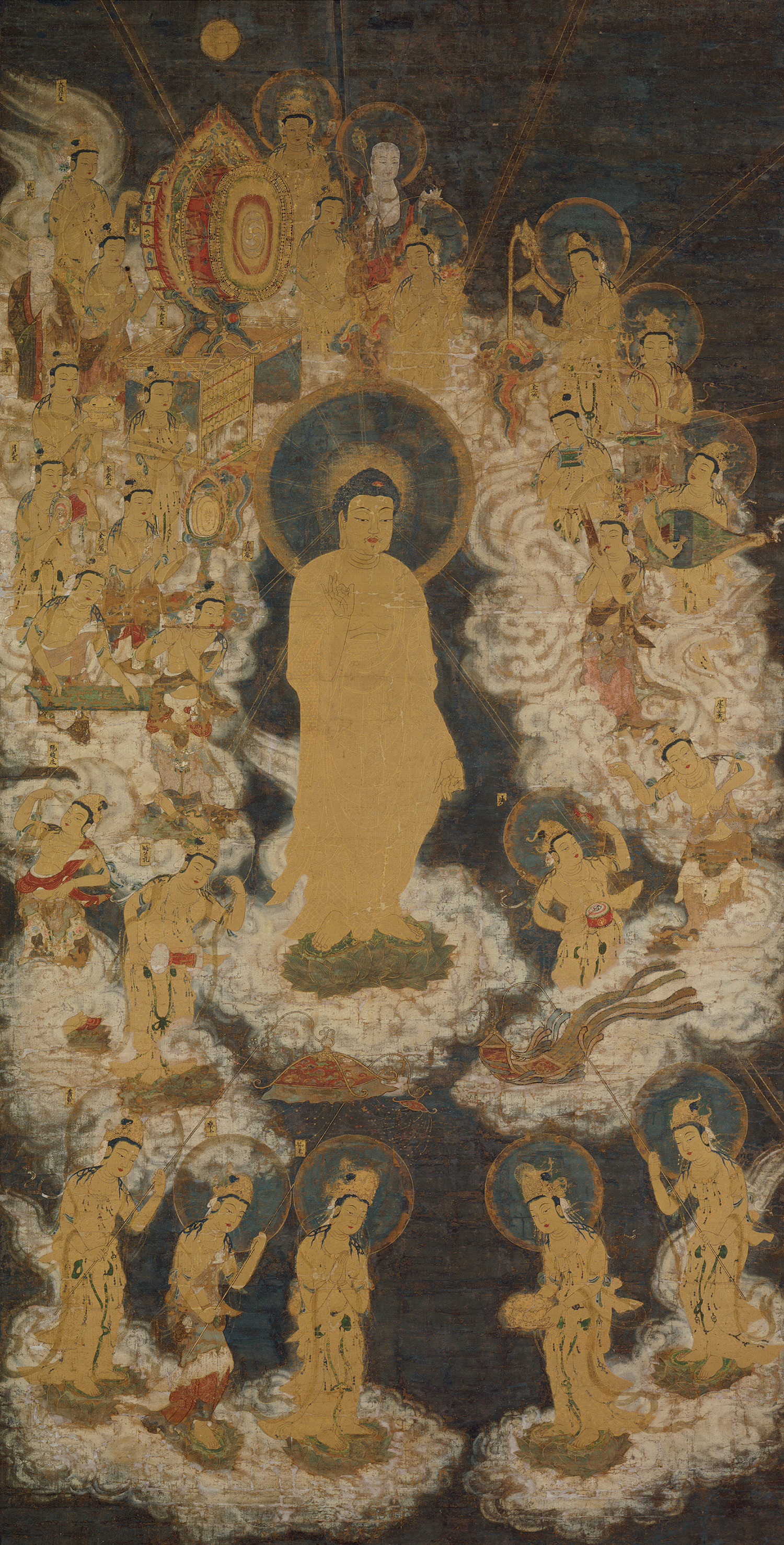
The image of Amida's descent (raigô 来迎) is from the Metropolitan Museum collection.

Sunday, November 20, 2011

Robert Hass Beaten by Police at OccupyCal

Robert Hass, former American poet laureate who is probably best known to haiku readers for his book The Essential Haiku: Versions of Basho, Buson, and Issa, has an article in today's New York Times. He and his wife, Brenda Hillman, were visiting Occupy Berkeley (OccupyCal) at the University of California Berkeley. Hass (a man in his 70s) and Hillman were among the members of the crowd who were beaten by the police. Here is a link to his essay:


Poet-Bashing Police

In the US, there's a close connection between haiku and the Beat Poetry movement. For that reason, I particularly liked Hass's remark here:
The next night the students put the tents back up. Students filled the plaza again with a festive atmosphere. And lots of signs. (The one from the English Department contingent read “Beat Poets, not beat poets.”) 
Here's a link to Hass's haiku book. Essential Haiku: Versions of Basho, Buson, and Issa by Robert Hass - Powell's Books

Wednesday, November 16, 2011

Some Genji waka, Part I

My student, Zhongyu Zhang, is working on some waka from the Tale of Genji for his paper in my class Tale of Genji: Sensuality and Salvation. I've never read these in the original before, and I don't know much about translating waka, so I'm going to work on them a little here.

From Autumn Excursion 紅葉賀

よそへつつ見るに心は慰まで露けさまさる撫子の花

though I see his likeness there
     it does not comfort my heart;
the dew of tears
     is  all the more drenching --
     wild carnation

袖ぬるる露のゆかりと思ふにも なほうとまれぬ大和撫子

thinking him
    the cause of the dew
that soaks your sleeves
    I feel all the colder towards him --
    Japanese carnation

(More follows, after the cut.........)>>

Sunday, November 13, 2011

New Book: Literature of 3.11

I'm interested in reading a new book of literature related to the Great East Japan Earthquake and Tsunami that is scheduled to be published simultaneously in Japanese, English, and French. Below are links to articles from Asahi Japan Watch (E) and Asahi Shimbun (J).

Collections of literary works on quake to hit U.S., Britain, France

東日本大震災テーマの日本文学作品集、米英仏で出版へ
 
I confess that generally I'm reluctant to read this kind of thing because it's often too powerful, but it may be that I can use something in it for my classes, so I'll give it a try.

The 3.11 disaster is so overwhelming. I'm trying to understand it/know about it just a little. Perhaps the stories in this book might help.