Sunday, January 6, 2013

Sketchbook Project 2013: The Great Learning/大學

I finished my entry for Sketchbook Project 2013. A bit of a kakizome 書初め for the new year and a commemoration of last semester's service-learning project, it's a translation of The Great Learning. The paper in the sketchbook that you get when you sign up is not very fancy, so I took it out and rebound it using slightly heavier stock. It turned out to still be relatively transparent, but it stood up pretty well to the ink and pens that I used.

Portions of the Sketchbook Project library are displayed throughout the year in various US cities. I saw the exhibition when it came to Atlanta in the summer and it was fun. It's nice to go to an event that allows people to make art as well as view it, where it can be held and touched and not just venerated from a distance.

Eventually the Sketchbook Project people will digitize the book and post it online. In the meantime, here's what it looks like.


Click "Read More" for the rest.

Wednesday, January 2, 2013

The Way of Great Learning 大學之道

Having worked on neo-Confucianism one way or another all of last semester, I start the year with a translation of the central part of the text of Daxue (Great Learning).

大學之道,在明明德,在親民,在止於至善。知止而後有定,定而後能靜,靜而後能安,安而後能慮,慮而後能得。物有本末,事有終始,知所先後,則近道矣。

The Way of Great Learning is to make shining virtue manifestly clear, to renew the people, and to rest in the achievement of good. Knowing where to rest, then you achieve stability; with stability, then you can be calm; being calm, then you can be secure; being secure, then you can become considerate; being considerate, then you can achieve potential. Things have roots and branches; affairs have beginnings and ends; knowing what comes before and after, that will lead you closer to the Way.

古之欲明明德於天下者,先治其國;欲治其國者,先齊其家;欲齊其家者,先修其身;欲修其身者,先正其心;欲正其心者,先誠其意;欲誠其意者,先致其知,致知在格物。

In the ancient past, the people of the world who wished to make shining virtue manifestly clear first brought civil government the nation; those who wished to bring civil government to the nation first created order in their families; those who wished to create order in their families first cultivated themselves; those who wished to cultivate themselves first corrected their hearts; those who wished to correct their hearts first made their intentions sincere; those who wished to make their intentions sincere first gain knowledge. Gaining knowledge exists in the investigation of things.

物格而後知至,知至而後意誠,意誠而後心正,心正而後身修,身修而後家齊,家齊而後國治,國治而後天下平。自天子以至於庶人,壹是皆以修身為本。其本亂而末治者否矣,其所厚者薄,而其所薄者厚,未之有也!此謂知本,此謂知之至也。

After investigating things, you then achieve knowledge; having achieved knowledge, your intentions become sincere; with your intentions sincere, your heart then is corrected; with your heart corrected, your self is cultivated; with your self cultivated, then your family is ordered; with your family ordered, then your nation is governed civilly; with your nation governed civilly, all under heaven is at peace. From the Son of Heaven down to the common people, cultivation of the self is fundamental for everyone. If the root is in disarray, the branches are not orderly. It has never been the case that the important is properly treated as trivial, and the trivial as important! This cultivation of self is what is called the foundation of knowledge; this is what is called knowledge's ultimate achievement.
# # #

Before I let Daxue go, I've got one last task to commemorate it: a contribution to The Sketchbook Project 2013. The deadline is January 15, so I have to get going on it. If it's any good, I'll post scans of the pages here. Happy new year, in the meantime. Is there such a thing as 初ブログ記事? Anyway, あけましておめでとうございます。


Wednesday, December 19, 2012

Exhibition Blog

The exhibition now has its own blog!

明明徳 Clearly Manifesting Luminous Virtue

If you can't visit Clarkston, stop by the virtual galleries instead.

Friday, December 14, 2012

Too much grief

day 890 12-14-2012
the small explosions
we were sure we heard again
swallowed by silence

From www.haikudiem.com

Wednesday, December 12, 2012

Art Exhibition Celebrates Partnership of Emory Freshmen and Clarkston Refugees

The recently opened exhibition "Clearly Manifesting Luminous Virtue" displays the brush calligraphy of students in a freshman seminar and from Clarkston Community Center's Senior Refugee Program. Despite their differences, the Emory and Clarkston students proved to have much in common: all were newcomers to the Atlanta area and all were devoted to learning. While it was not always possible to communicate with words, students learned to appreciate each other through gestures, smiles, and patient brushwork. The exhibition presents the strikingly expressive art that emerged from these sessions.

With support from Emory's Center for Community Partnerships, the group of 16 freshmen made weekly visits to the students of the Senior Refugee Classes to chat in English and share the pleasure of writing with a brush. The exhibition's title is a phrase from one of the freshman class's textbooks, The Greater Learning (Chinese, Daxue) one of the most influential works of Chinese ethics. The book explains that students should try fulfill their potential by study and practicing the arts, including calligraphy. By improving themselves, claims the Greater Learning, students are able to support their families. By supporting families, they create community. By creating community, they bring peace to the world.

Students of the freshman seminar East Asian Calligraphy in the Community, taught by associate professor of Japanese Cheryl Crowley, explored the possibilities of putting these abstract ideas into practice. They first learned the basics of the classical Chinese scholarly art of calligraphy, and then joined students from the Clarkston refugee community to collaborate in studying it during weekly visits over a period of two months. The Clarkston students, elders from the Senior Refugee Program taught by Teresa Hatton and Sheilah Bowser, attend English as a Second Language classes at the Center. They come from places as diverse as Bhutan, Somalia, and Ethiopia and Eritrea.

The exhibition is on display from December 7 - 31, 2012 at Clarkston Community Center, 3701 College Avenue, Clarkston, GA 30021 (404) 508-1050.

Additional funding was provided by Emory's East Asian Studies Program and Confucius Institute.

Saturday, November 24, 2012

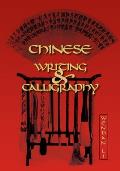
Recommended: Chinese Writing and Calligraphy

Wendan LI teaches at the University of North Carolina. I met her last month at the American Society of Shufa Calligraphy Educators' 8th International Conference on Hanzi Shufa Calligraphy Education at Southwestern University in Georgetown, Texas.

While I was there I heard about her book, Chinese Writing and Calligraphy, and it looked so good I bought a copy. It is an excellent resource both for people who are interested in learning more about calligraphy but don't have a teacher to work with, as well as teachers who would like a textbook suitable for people who don't read Chinese or Japanese.

It has a thorough introduction to the history of Chinese characters, as well as the aesthetic principles behind their construction as artistic forms. Also included are explanations of the tools of calligraphy and finally a large section of practice exercises in standard style 楷書.  What's nice about this book is that Professor Li is a specialist in linguistics, so the information she provides is scholarly and reliable. She is also a practicing calligrapher herself, so not only are the illustrations in the historical section very instructive, but the models provided in the practice exercise are so elegant and graceful you just want to copy them. In short, the book is an excellent foundational text for the anglophone classroom.

Wendan Li. Chinese Writing and Calligraphy (Latitude 20 Books). Hawaii: University of Hawai’i Press (2010) ISBN: 0824833643